When people say "the veil is thin," they mean the boundary between the world of the living and the world of spirits is believed to be easier to cross, so the dead, the fairy folk, and other spirits can come closer and messages pass more easily between the two. Most people say the veil is thinnest at Samhain, on October 31 and November 1, and many feel it thinning all through October. The idea goes back to the Gaelic belief that the doors to the Otherworld opened on Samhain night.
What Does "The Veil Is Thin" Mean?
"The veil is thin" means the line between our everyday world and the spirit world is believed to be weaker than usual. The "veil" is a way of describing that boundary, the curtain between the living and the dead, and when it's thin, people say spirits can visit, ancestors feel close, and intuition, dreams, and divination come through more clearly.
When someone says "the veil is thinning," they usually mean the season is moving toward one of those times, most often Samhain. You'll also hear "the veil between worlds," which means the same thing.
Where the Idea Comes From
The idea comes from Gaelic Ireland and Scotland, where Samhain was the night the Otherworld opened. People believed the Aos Sí, the fairy folk who lived inside the ancient mounds, could come out and walk among the living, and that the dead returned to visit the homes they had lived in. Families set out food for both and kept places at the table for their dead.
Irish storytelling is full of Samhain crossings. The cave of Oweynagat at Rathcroghan, in County Roscommon, was known as one of Ireland's gateways to the Otherworld, and old tales say that on Samhain night wild creatures poured out of it into the world. The Irish government's own guide to the spirits of Samhain describes the veil between this world and the world of the dead growing thin, letting the púca, the banshee, and the water horse cross over.
The word "veil" itself is a later English way of describing that open boundary. Modern pagans and Wiccans took up the phrase in the 20th century, and today "the veil is thin" is the most common way to talk about the season. Our guide to what Samhain is covers the festival's full history.
When Is the Veil the Thinnest?
The veil is believed to be thinnest at Samhain, from sunset on October 31 to sunset on November 1. Many practitioners feel it start to thin after the autumn equinox and grow thinner through October.
Other times people associate with a thin veil include:
- Beltane, April 30 to May 1. Beltane sits exactly opposite Samhain on the Wheel of the Year, and in Gaelic tradition the Aos Sí were also especially active then. Our Beltane correspondences cover the festival.
- The Southern Hemisphere's Samhain, April 30 to May 1. South of the equator the seasons are reversed, so many pagans there feel the veil thinnest in late April.
- In-between times of day. Dawn, dusk, and midnight are traditional "between" times, neither one thing nor the other, and many people feel spirits closest then.
- Personal anniversaries. Many people feel the veil thin on the birthday or death anniversary of someone they've lost, whatever the season.
Día de los Muertos, on November 1 and 2, is a separate Mexican tradition with its own beliefs about the dead returning, and its customs are best learned from the families and communities who keep them.
Is the Veil Thin Right Now?
If it's October, many practitioners would say yes, the veil is thinning now and will be at its thinnest on Samhain night. In 2026, Samhain falls from sunset on Saturday, October 31, to sunset on Sunday, November 1, and some people keep the astronomical midpoint around November 7 as well. After that, most people feel the veil slowly close again through November.
Signs the Veil Is Thin
People who feel the veil thinning often describe the same kinds of experiences. Skeptics explain many of these in everyday terms, while many practitioners take them as real contact with the spirit world, and both views have a long history. Common signs people report include:
- Vivid dreams of loved ones who have died, often feeling more like a visit than a dream.
- A sense of someone in the room, or a feeling of being watched in a comforting or curious way.
- Scents with no source, such as a grandmother's perfume, pipe smoke, or a favorite food cooking.
- Pets staring or reacting to an empty spot, or acting unsettled at night.
- Lights or electronics flickering, or radios and phones behaving oddly.
- Stronger intuition and clearer readings, with tarot, pendulums, or scrying feeling easier than usual.
- Repeating signs, like the same number, song, or animal appearing again and again. Our guides to the crow, the owl, and the moth cover animals often linked to messages from the dead.
What to Do When the Veil Is Thin
When the veil is thin, many practitioners honor their ancestors, try divination, and protect their homes. Here are a few ways to work with the season:
- Honor your ancestors. Set up an ancestor altar with photos and a candle, or hold a dumb supper, a silent meal with a place set for the dead. Our Samhain rituals include a 10-minute candle ritual for the people you miss.
- Try divination. Readings are said to come through more clearly when the veil is thin. Try tarot, a pendulum, or scrying with a crystal ball or dark mirror.
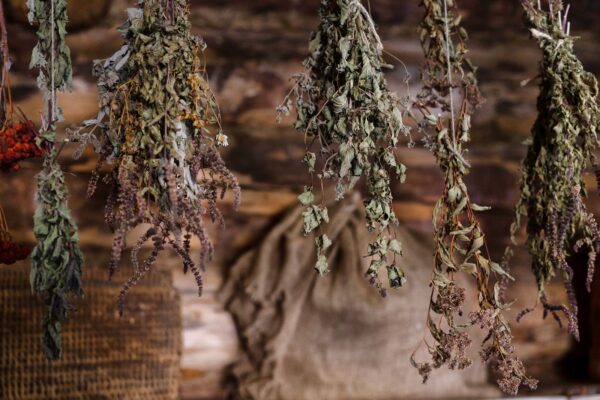
- Pay attention to your dreams. Keep a notebook by the bed, and if you'd like, tuck dried mugwort under your pillow, an herb long used for dreaming.
- Use a spirit board with care. If you want to try a spirit board, open and close the session with clear intentions.
- Protect your home. Sweep your threshold with a besom, lay a line of black salt across the door, or set a turnip lantern in the window the way Irish and Scottish families once did.
- Leave an offering. Bread, apples, milk, or a plate from dinner, left out overnight, is the oldest Samhain way to welcome the dead and keep the fairy folk happy. Here are 13 traditional Samhain offerings.
What Are Thin Places?
Thin places are spots on the land where the boundary between this world and the spiritual one feels especially thin, so people sense the sacred more easily there. They're usually wild or old places, such as holy islands, mountains, wells, ancient burial mounds, and ruined churches.
The idea is often called an old Celtic saying, but the earliest written uses of the phrase are from the 20th century. It's most closely tied to George MacLeod, the Scottish minister who founded the Iona Community in 1938 and described the island of Iona as a place where only a very thin layer separates the material and the spiritual. The travel writer Eric Weiner made the phrase popular in a 2012 New York Times essay that named places like Iona and Croagh Patrick, Ireland's holy mountain, as thin places.
Places tied to Samhain itself make a good list too: the Hill of Tara, where the great Samhain feast was held, the Hill of Ward, where the Samhain fire was lit, the cave of Oweynagat at Rathcroghan, and the fairy forts and mounds found all over the Irish countryside. Many people also find their own thin places closer to home, like a family grave, an old tree, or the spot where they always feel calm.
Staying Grounded When the Veil Is Thin
A thin veil can make spirit work feel stronger, so it helps to protect yourself and close what you open. Set a clear intention before any ritual or reading that only spirits who come in peace may approach, and end every session by thanking anyone you called and saying out loud that the session is closed.
If you ever feel uneasy, turn on the lights, eat something, and put your hands or bare feet on the earth to ground yourself. The season can also bring up grief, especially if you've lost someone recently. Magic walks alongside care, never in place of it, so lean on the people around you or someone trained to help if it feels heavy.
The Veil Is Thin FAQ
What does it mean when the veil is thin?
When the veil is thin, the boundary between the living world and the spirit world is believed to be easier to cross. People say spirits and ancestors come closer, and dreams, intuition, and divination come through more clearly.
When is the veil the thinnest?
The veil is believed to be thinnest at Samhain, from sunset on October 31 to sunset on November 1. Many people also feel it thin at Beltane, April 30 to May 1, and at dawn, dusk, and midnight.
Is the veil thin right now?
If it's October, many practitioners say the veil is thinning now and will be thinnest on Samhain night, October 31. In 2026, Samhain runs from sunset on October 31 to sunset on November 1.
Why is the veil thin at Samhain?
The veil is said to be thin at Samhain because it marks the turning point between the light and dark halves of the year. In Gaelic tradition it was the night the Otherworld opened, the dead came home, and the fairy folk walked among the living.
What are the signs the veil is thin?
Common signs people report include vivid dreams of loved ones who have died, a sense of someone nearby, scents with no source, pets reacting to empty spaces, flickering lights, and clearer divination.
What is a thin place?
A thin place is a spot where the boundary between this world and the spiritual one feels especially thin, such as a holy island, a mountain, or an ancient site. The phrase is linked to Celtic Christianity and became popular through Iona in the 20th century.