The first jack-o'-lanterns were carved from turnips, not pumpkins. In 19th-century Ireland, Scotland, and parts of England, people hollowed out turnips on Halloween, carved faces into them, and set a candle inside to frighten passersby and keep harmful spirits away. Irish and Scottish immigrants brought the custom to North America, where the bigger, softer pumpkin took over. The old turnip lantern is smaller and much creepier, and you can still carve one yourself.
Were Jack-o'-Lanterns Originally Turnips?
Yes, the original jack-o'-lanterns were turnips, along with other root vegetables like mangelwurzels and, now and then, a large potato. Carved vegetable lanterns were common in Ireland, Scotland, Wales, and England through the 1800s, and they were part of the Samhain night that became Halloween.
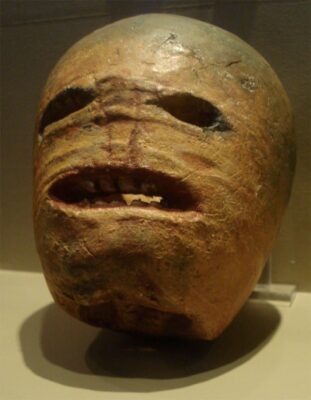
The National Museum of Ireland has one of the best surviving examples, known as the "ghost turnip." In 1943, a schoolteacher near Fintown, County Donegal, sent the museum a Halloween turnip lantern of the kind that was always made in her area around 1900. The real turnip was falling apart, so the museum's artist made a painted plaster cast of it, and the cast is on display today at the Museum of Country Life in County Mayo. It has since become famous online for how eerie it looks.
The custom turns up all over the islands. In Scotland, children carried carved turnips called tumshie heads, the Isle of Man still carves turnip lanterns for Hop-tu-Naa on October 31, and in Somerset, England, children carry mangelwurzel lanterns on Punkie Night in late October.
Was It a Turnip or a Rutabaga?
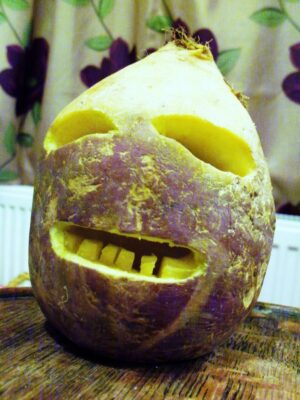
Many "turnip" lanterns were what Americans call a rutabaga. In Ireland and Scotland the big yellow-fleshed rutabaga is simply called a turnip, and the Scots also call it a neep. In England it usually goes by swede.
Either one makes a good lantern. A rutabaga is bigger and gives you more room to carve, and a white turnip is smaller, softer, and quicker to hollow. If your grocery store only has small turnips, look for rutabagas near the potatoes, where they are often sold coated in wax.
Why Did People Carve Turnips at Samhain?
People carved turnip lanterns to stand in for the spirits that were out on Samhain night, and to keep the harmful ones away from home. Samhain was the night the dead came back to visit and the fairy folk walked abroad, and a grinning face lit from inside was meant to look like one of them.
The lanterns had a few jobs. Young people carried them around to frighten their neighbors, a bit of mischief that went along with guising, the costumed door-to-door visiting that became trick-or-treating. Set on a windowsill, a turnip lantern was believed to keep unwelcome spirits from coming in. Some historians also think the glowing faces stood for the souls of the dead, since Halloween falls on the eve of All Saints' Day and All Souls' Day. Our guide to what Samhain is covers the festival behind all of this.
The Legend of Stingy Jack
Stingy Jack is the Irish folktale that explains where jack-o'-lanterns come from. Jack was a drunk and a trickster, sometimes a blacksmith, who fooled the Devil twice and ended up wandering the earth forever with a coal in a hollowed turnip to light his way. There is no single official version, so every storyteller tells it a little differently, but most go something like this.
One night the Devil came to collect Jack's soul, and Jack asked for one last drink at the pub first. When it came time to pay, Jack talked the Devil into turning himself into a coin. Jack quickly slipped the coin into his pocket next to a small silver cross, and the Devil was trapped. Jack let him go only after the Devil promised to leave him alone for ten more years.
When the ten years were up, the Devil came back. Jack asked him to climb an apple tree and pick him one last apple, and as soon as the Devil was in the branches, Jack carved a cross into the trunk. The Devil couldn't climb down past it. This time Jack made him promise never to take his soul at all.
When Jack finally died, Heaven wouldn't let in such a liar and a cheat, and Hell couldn't take him because of the promise. The Devil sent him off into the dark with a single burning coal from the fires of Hell. Jack put the coal inside a turnip he had been eating, and he has been wandering ever since, a lost soul with his little lantern. People called him "Jack of the Lantern," then "Jack O'Lantern."
The story has relatives across Britain. In a version from Shropshire, England, a wicked blacksmith named Will is given a coal by the Devil and wanders the marshes with it, leading travelers astray as a will-o'-the-wisp. In Irish, the same wandering light is called Seán na Gealaí, "Jack of the moonlight." The Stingy Jack legend was being dramatized in print by 1851, when the Irish writer Hercules Ellis published a poem about him.
Is Stingy Jack Real?
Stingy Jack is a character from folklore, not a real person, and there is no record of an actual blacksmith or drunkard behind the story. Like many folktales, it gave people a memorable way to explain a custom they already had.
Where the Name Jack-o'-Lantern Comes From
The name jack-o'-lantern is older than the carved lantern. In the 1600s, it meant two things in England: a night watchman or any man carrying a lantern, and the ignis fatuus, the "foolish fire" of ghostly lights seen over marshes at night. "Jack" was simply the everyday name for any ordinary man, the way we might say "some guy."
The word was first used for a lantern carved from a turnip or pumpkin in 1837. The marsh lights, the wandering soul in the Stingy Jack story, and the glowing face on the windowsill all share the name, and they all share the same idea: a little light moving in the dark that may not be entirely of this world.
Why Do We Carve Pumpkins on Halloween?
We carve pumpkins on Halloween because Irish and Scottish immigrants brought the turnip lantern custom to North America in the 1800s, and the pumpkin, which is native to the Americas, made a far easier lantern. A pumpkin is bigger, hollow inside, and soft enough to carve with a kitchen knife, so the new country's jack-o'-lanterns quickly turned orange.
At first, American pumpkin lanterns were a general harvest-season decoration, and some people made them for Thanksgiving. By the late 1800s they had become a fixture of Halloween, and newspapers were writing about carved pumpkins on October 31 by the 1860s. The custom then traveled back across the Atlantic: pumpkins became easy to buy in Ireland and Britain in the 1980s, and they mostly replaced the turnip there too.
How to Carve a Turnip Jack-o'-Lantern
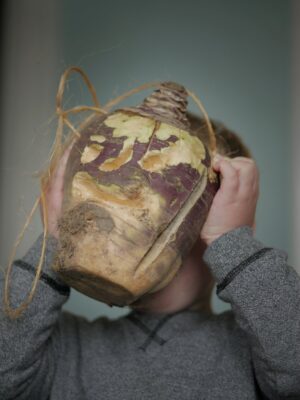
You can carve a turnip jack-o'-lantern by slicing off the top, scooping out the flesh with a sturdy spoon, carving a face with a small knife, and lighting it with a tealight. Turnip flesh is dense and hard, so expect it to take 30 minutes to an hour, and give yourself time.
What you need:
- One large, firm turnip or rutabaga, ideally one that sits flat
- A sharp paring knife
- A sturdy metal spoon, melon baller, or grapefruit spoon
- A marker for drawing the face
- A tealight candle or a battery tealight
- Optional: string or thin wire for a carrying handle
Steps:
- Slice about half an inch off the top of the turnip to make a lid. If it wobbles, cut a thin slice off the bottom so it stands flat.
- Cut a crisscross pattern into the exposed flesh with the paring knife, about an inch deep. This breaks up the flesh so it scoops out more easily.
- Scoop out the loosened flesh with the spoon or melon baller, then cut and scoop again until the turnip is hollow. Leave the walls about half an inch thick so the lantern holds its shape.
- Draw a face on the outside with the marker. Small, simple features work best, since the walls are thick and a turnip is much smaller than a pumpkin.
- Carve along your lines with the paring knife, pushing the pieces out from the inside if they stick.
- Cut a small hole in the lid so the heat and smoke from the candle can escape.
- If you want a handle like the old carried lanterns, poke two holes on opposite sides near the rim and thread a length of string or wire through them.
- Set the tealight inside, light it, and put the lid on.
When the candle burns, the lid will slowly scorch and the whole house will smell faintly of roasting turnip.
A few safety notes: let adults do the cutting, always cut away from your hand, and never leave a lit candle unattended. A battery tealight is the better choice for children's lanterns or anywhere near curtains. A carved turnip shrinks and wrinkles as it dries over the next several days, and many people think that makes the face even spookier.
Don't throw away the flesh you scooped out. Rutabaga and turnip are good boiled and mashed with butter, salt, and pepper, the way Scotland serves "neeps," and they are just as good added to a soup or stew.
Using a Turnip Lantern at Samhain
A turnip lantern fits right into a Samhain practice, both as a protector and as a light for the dead. Many practitioners set one on a windowsill or by the front door on October 31 to keep unwelcome spirits away, the same job it did in Irish and Scottish homes.
You can also set a lantern on your Samhain altar beside photos of your ancestors, or light one in the window during a dumb supper to guide your loved ones home.
When you light it, you can say a short verse like this one:
Little light in turnip's keep,
Guard this house while others sleep.
Turnip Jack-o'-Lantern FAQ
What was the original jack-o'-lantern?
The original jack-o'-lantern was a carved turnip, rutabaga, or other root vegetable, made in Ireland, Scotland, and parts of England in the 1800s. Pumpkins only replaced turnips after Irish and Scottish immigrants brought the custom to North America.
Why did the Irish carve turnips?
The Irish carved turnips on Halloween to make lanterns that looked like the spirits abroad on Samhain night. They used them to frighten their neighbors and set them on windowsills to keep harmful spirits away from the house.
What is the story of Stingy Jack?
Stingy Jack is an Irish folktale about a drunk and trickster who fooled the Devil twice, once by trapping him as a coin and once by trapping him in an apple tree. When Jack died, neither Heaven nor Hell would take him, so he wanders the earth with a burning coal inside a carved turnip.
Why do we carve pumpkins instead of turnips?
We carve pumpkins because they grew everywhere in North America and are much bigger and softer than turnips, so Irish and Scottish immigrants switched to them in the 1800s. Pumpkins later became easy to buy in Ireland and Britain too, and they replaced turnips there by the 1980s.
Is a turnip lantern made from a turnip or a rutabaga?
A turnip lantern can be made from either one. In Ireland and Scotland, the large rutabaga is called a turnip, so many traditional "turnip" lanterns were actually rutabagas.
How long does a carved turnip last?
A carved turnip usually lasts several days before it shrinks and wrinkles as it dries out. Keeping it somewhere cool when it isn't lit will help it last longer.
Is it hard to carve a turnip?
Carving a turnip is harder than carving a pumpkin because the flesh is solid and dense. Cutting a crisscross pattern into the flesh before you scoop makes it much easier, and a melon baller or grapefruit spoon helps too.