A dumb supper is a meal eaten in complete silence, with an empty chair and a full plate set for the dead. Most people hold one on Samhain night, October 31, when the boundary between the living and the dead is said to be at its thinnest. "Dumb" is the old word for silent, and the silence is the whole point: nobody speaks from the moment the candles are lit until the meal is over, so the ancestors get the room to themselves. Samhain falls in the middle of Scorpio season, a month astrologers tie to endings and the unseen.
If you have never done one, it is simpler than it sounds. You cook, you set one extra place, you turn off the lights, you eat without a word, and you listen. This page covers where the tradition comes from, when to hold one, what to serve, the step-by-step ritual, and what to do when the silence ends.
- What Is a Dumb Supper?
- Where the Dumb Supper Comes From
- When to Hold a Dumb Supper
- What You Need
- How to Hold a Dumb Supper, Step by Step
- What to Serve at a Dumb Supper
- Words to Say Before the Silence
- Rules and Etiquette
- What to Do After the Supper
- Dumb Supper Variations
- Similar Traditions From Other Cultures
- Dumb Supper FAQ
What Is a Dumb Supper?
A dumb supper is a silent ritual meal shared with the dead, and in modern Pagan practice it is one of the ways people honor their ancestors at Samhain, alongside altars, offerings, and remembrance rites. The living cook a meal, lay one extra setting at the head of the table for the spirits, and eat the whole thing without speaking, singing, or touching a phone. The empty chair is treated as occupied: the ancestors are served first, their glass is filled, and nobody sits in that seat.
The meaning of the silence is easy to miss. In everyday life the dead only get a passing thought, a photo on a shelf, a name at a holiday. A dumb supper gives them an hour of undivided attention, and the quiet is what makes that possible. Without conversation, most people find themselves actually thinking about the person they set the plate for, remembering their voice, their cooking, their jokes. That attention is the offering. The food is just the excuse.
Where the Dumb Supper Comes From
The dumb supper started as a marriage divination rite in the rural British Isles and the American South, not as an ancestor ritual, and modern Pagans borrowed the name and the silence for something new. In the older folk version, a group of unmarried young women would cook a meal at midnight in total silence, doing everything backward: walking backward, setting the table in reverse order, sometimes baking a "dumb cake" with the recipe run in reverse. Then they sat and waited. The belief was that the apparition of each woman's future husband would walk in and take the seat set for him. Folklorists recorded the custom in England on St Mark's Eve and Midsummer Eve, in Scotland and parts of the American South on Christmas Eve and New Year's Eve, and in the Ozarks and Appalachia on Halloween, which is the version that stuck.
The best American record comes from Vance Randolph, who collected Ozark folklore in the 1920s through 1940s and wrote up the dumb supper in Ozark Superstitions (1947, later reprinted as Ozark Magic and Folklore). His version has the girls of a household cook in silence with their backs to the stove, set the table backward, and then wait at midnight for the shape of a future husband, or, in the grimmer tellings, a coffin, which meant the girl would die unmarried. Versions of the same rite were collected across Appalachia and the Ozarks.
Modern witches and Pagans took the name, the silence, and the backward table setting and turned it toward the dead. That repurposing happened in the late twentieth century as Wicca and eclectic Paganism revived Samhain as a festival of the ancestors. It fit naturally, because Samhain already carried the old Gaelic belief that the dead return to visit their homes on that night, and the broader custom of feeding the dead, the veneration of the dead, is one of the oldest religious practices on record and one of the most widespread. So the dumb supper you will hold this year is a genuinely old custom wearing a new purpose, and knowing that is part of doing it well.
When to Hold a Dumb Supper
Hold a dumb supper on the night of October 31, after dark, and if you can manage it, time the meal so that you are seated by midnight. Samhain is the traditional date because it is the Celtic festival of the dead and the point on the Wheel of the Year when the veil is said to thin. The same night is also Halloween and the start of Allhallowtide, the three Christian days for the dead, so the whole culture is already pointed in the right direction.
You do not have to wait for the exact date, and the dumb supper is not a Samhain-only ritual. Any night between October 31 and November 2 works, and many people hold the supper on the closest weekend so that family can attend. It is also a fitting ritual for the anniversary of a death, for the night before or after a funeral, for a Yule table with a chair left for someone who died that year, or for any night you want an hour with a person who is gone. The old folk version was held on Midsummer Eve, Christmas Eve, and New Year's Eve as often as on Halloween, so there is precedent for every season. The one rule is that it happens after dark, with the electric lights off.
What You Need for a Dumb Supper
You need a table, candles, one extra place setting, and a meal, and everything else is optional. Here is the full list:
- A black or dark tablecloth. Black is the color of the ancestors and of Samhain. If you do not own one, a dark sheet works, or a bare wooden table.
- Candles. Black candles are traditional for the ancestor's place, and white candles for the living. Taper or chime candles in sturdy holders are easiest at a dinner table; tea lights in glass cups are the safest option if children or pets are present. Our guide to black candles and their meaning explains why black belongs on this table, and you can find black candles and white candles in the shop.
- One extra place setting. A plate, glass, and cutlery for the ancestors, set at the head of the table. Some people use the dead person's own plate or cup if they have inherited one. That is a lovely touch, and it is the one place where a specific keepsake really earns its spot.
- Photographs and keepsakes. A photo of each person you are honoring, or an object they owned: a pipe, a ring, a recipe card, a pair of reading glasses. Arrange them around the ancestor's plate.
- Rosemary. A sprig on each plate, or tucked into the napkin. Rosemary has stood for remembrance in European custom since at least Shakespeare's time ("there's rosemary, that's for remembrance"), and a rosemary votive does the same work if fresh sprigs are out of season.
- A bell or a small chime. Used to open and close the silence so nobody has to speak to signal the start or end.
- Slips of paper and a pen. For guests to write a message to the dead during or after the meal.
- A fireproof dish. A cauldron, a cast-iron pan, or a large ceramic bowl with an inch of sand in the bottom, for burning the messages at the end.
- The meal. See What to Serve below.
How to Hold a Dumb Supper, Step by Step
The ritual runs from lighting the candles to ringing the closing bell, and it takes about an hour. Here is the order most people follow:
- Cook in silence if you can. In the old folk version the cooking itself was part of the rite. If you have the time, cook the meal without talking and without music. If that is not practical, cook normally and start the silence when you sit down.
- Set the table backward. Lay the ancestors' place first, at the head of the table, then the living. Set each place in reverse of how you normally would: glass first, then cutlery, then plate. The reversal comes straight from the old divination rite and marks the meal as outside ordinary time.
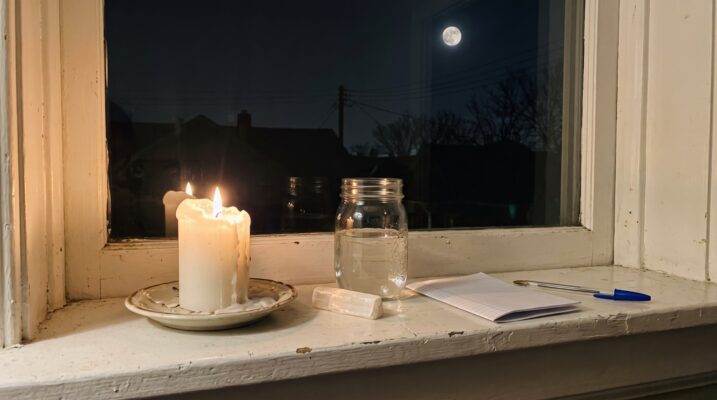
- Dim the house. Turn off every electric light in the room and, if you can, in the rooms visible from the table. Light the candles: black at the ancestors' seat, white at the living seats. Put phones in another room, switched off or silenced.
- Open with words, then the bell. Before the silence, one person reads an invocation aloud (see Words to Say). Then ring the bell once. From this point no one speaks.
- Serve the dead first. Fill the ancestors' plate with a portion of every dish and pour their drink before anyone else is served. Serve the rest of the table oldest to youngest.
- Eat in silence. Eat slowly. Pay attention to the empty chair, and to the person you set it for. If your mind wanders, bring it back to a memory of them. If you feel like crying, cry; it is quiet, and it is allowed. If someone laughs, ignore it and carry on. The silence is not a test.
- Write to the dead. When you have finished eating, take a slip of paper and write a message to the person you are honoring: something you never said, a thank-you, a question, an apology. Fold it and place it under the ancestors' plate or in the fireproof dish.
- Sit with them a while. Give a few minutes to nothing at all. Watch the candles. Some people report a sense of presence in this stretch. If nothing happens, nothing happens, and the meal was still an offering.
- Close the silence. Ring the bell once. The oldest person present says a short closing line aloud, such as "Thank you for sitting with us. Go in peace, and return when you are welcome." Now everyone may speak.
- Burn the messages. Carry the fireproof dish outside or set it in the sink, and burn the slips of paper one by one. Let the ash cool completely before you dispose of it.
- Take the offering plate out. Carry the ancestors' plate and glass outside and leave the food at the base of a tree, on the ground, or on the porch; pour the drink onto the earth. Keep chocolate, alcohol, grapes, and onions off an outdoor offering plate if there are dogs, cats, or wildlife nearby, because all four are poisonous to animals. If you cannot leave food outdoors, compost it or bury it. Nobody eats from that plate.
What to Serve at a Dumb Supper
Serve the dead person's favorite dish if you know it, and fill the rest of the table with autumn food: apples, root vegetables, bread, and something from the old Samhain kitchen. The menu does not need to be elaborate. A single pot of stew with bread and a plate of apples is a complete dumb supper. Here is what carries meaning on this table:
| Dish | Why It Belongs | Notes |
|---|---|---|
| The ancestor's favorite meal | This is the single most powerful thing you can put on the table, because it makes the offering personal. | Grandma's pot roast, Dad's chili, a great-aunt's lemon bars. If you inherited a recipe card, cook from it. |
| Colcannon | Mashed potatoes with cabbage or kale is the classic Irish Halloween dish, and charms were once hidden in it for divination. | Skip the hidden charms if children are eating; a ring in a mouthful of potato is a choking hazard. |
| Barmbrack | This Irish fruit bread was baked with a ring, a coin, and a rag inside to tell the eater's fortune for the coming year. | Use it as the bread for the table. Store-bought is fine; a plain raisin loaf stands in. |
| Soul cakes | Small spiced cakes were given out to "soulers" who went door to door on All Souls' Day and offered to say a prayer for the household's dead. | Any small spiced cake or shortbread marked with a cross works. |
| Apples | Apples are the fruit of Samhain, tied to apple bobbing and to the old Celtic image of the otherworld as an island of apples. | Serve them whole, baked, or as cider. Cut one crosswise to show the pentagram of seeds. |
| Pomegranate | The pomegranate is the fruit of the underworld in the Greek story of Persephone, and it is in season in late October. | Split one and put a few seeds on the ancestors' plate. |
| Roasted root vegetables | Beets, turnips, parsnips, and carrots grow in the dark, which is why they are the vegetables of the season of the dead. | Roast with olive oil, salt, and rosemary. Turnips also honor the original Irish jack-o'-lantern. |
| Bread and salt | Bread and salt together are the oldest offering of hospitality in Europe. | A small dish of plain salt beside the ancestors' plate is enough. |
| Cider, wine, or water | The ancestors' glass gets whatever they drank, or plain water if you do not know. | Water is never wrong. |
For children, add something they will actually eat. A dumb supper does not have to be somber food, and a plate of the dead person's favorite cookies is as valid an offering as anything on this list.
Words to Say Before the Silence
Read one short invocation aloud before ringing the bell, and keep it plain, because the silence that follows will do the heavy lifting. Here is one you can use or adapt:
Tonight the veil is thin.
We set this place for those who came before us:
the ones we knew, the ones we never met,
the ones whose names we carry and the ones whose names are lost.
Sit with us. Eat with us. You are welcome at this table.
We will keep silence so that you may be heard.
If you are honoring specific people, say their names after "we set this place," one at a time, and let each name land before the next. If a guest wants to add a name, let them. The invocation is the only part of the supper where the living speak, so give it room.
A shorter affirmation works for a solo supper:
I remember you. I set your place. I am listening.
For the closing, after the bell, any of these is enough:
- "Thank you for sitting with us. Go in peace, and return when you are welcome."
- "The meal is done and the door is open. Walk gently."
- "We remember you. We will remember you again."
Dumb Supper Rules and Etiquette
The only hard rule is silence from the opening bell to the closing bell, and everything else is courtesy to the dead and to the other people at the table. In practice:
- No talking, no whispering, no humming. If something urgent comes up, write it on a slip of paper.
- No phones at the table. Not silenced, not face down. In another room.
- Nobody sits in the ancestors' chair. Pull it out slightly from the table so that it is clearly reserved.
- Serve the dead first, then the eldest living, then down to the youngest. This is the order of respect.
- Do not clear the ancestors' plate during the meal. It stays until the closing bell.
- Tell guests the rules before they arrive. A dumb supper with someone who did not know it would be silent is an awkward hour for everyone.
- Children are welcome. Give them a job: lighting a candle under supervision, placing the rosemary, or ringing the bell. A child who breaks the silence has not ruined anything.
- Guests may honor their own dead. Invite each person to bring a photo or keepsake, and to write a name on a slip of paper to place by the plate. The table belongs to everyone's ancestors.
- Leave the room as you found it. Wax, ash, and crumbs get cleaned up the same night. The dead are guests, not an excuse for a mess.
What to Do After the Supper
After the closing bell, burn the messages, carry the offering plate outside, and then talk. The time after a dumb supper is often the best part: people who have just spent an hour thinking about a dead parent or grandparent tend to want to tell stories about them, and letting that happen around the cleared table is a second, unplanned ritual.
A few specific things to do:
- Burn the slips of paper in the fireproof dish, one by one. If you wrote to the same person every year, keep an eye on what you asked for; the answers tend to show up in dreams over the following week.
- Set out the offering plate as described in step 11, minding the pet-safety list.
- Let the ancestors' candle burn down if it is in a safe holder and someone stays in the room. Otherwise snuff it. Some traditions say never to blow out a ritual candle; a snuffer or a wet fingertip on the wick avoids the argument.
- Keep the photos up through November 2. The three days of Allhallowtide are all days of the dead, and there is no reason to put Grandma back in the drawer on the first.
- Write it down. Note who you honored, what you served, and anything you felt or dreamed afterward. Next year's supper starts from these notes.
- Cleanse the space the following day if it feels heavy. A pinch of black salt at the threshold, a wipe-down of the table with a few drops of Florida Water in a bowl of water, or simply opening the windows for an hour all reset the room.
Dumb Supper Variations
The dumb supper bends to fit a solo practitioner, a small apartment, a family with young children, or a coven, and each version keeps the same core: silence, an empty place, and an offering.
- Solo supper. Set two places, yours and theirs. Light one black candle and one white. Read the short affirmation, ring the bell (or tap a glass), and eat. A solo supper can be as short as twenty minutes, and some people find it more intense than the group version because there is nowhere for attention to go but the empty chair.
- Apartment supper. If you cannot leave food outdoors, put the offering plate on a windowsill overnight and compost it in the morning. A single tea light in a glass cup stands in for the candle. The silence works the same in a studio as in a farmhouse.
- Family supper with young children. Shorten it. Aim for fifteen minutes of silence, give each child a candle to watch, and tell them ahead of time who the empty chair is for and one story about that person. Children often take the silence more seriously than adults expect.
- Coven or group supper. Assign roles: one person to read the invocation, one to serve, one to ring the bell, one to carry the offering out. A larger group can set one ancestors' place per household or one shared place at the head of the table.
- Ancestor altar instead of a table. If a full meal is out of reach, a plate of bread and an apple on your Samhain altar, eaten in silence beside it, is a dumb supper in miniature. Our page on Samhain offerings covers what to leave on the altar.
Similar Traditions From Other Cultures
Feeding the dead is one of the most widespread customs on earth, and the dumb supper is the British and American folk entry in a very long list. Nearly every culture has a day, a season, or a meal when the family sets food out for its ancestors, and several of them share the dumb supper's most specific details: an empty seat, a plate served first, a meal after dark, and a house left open for the visitors. Seeing the other traditions side by side shows what the dumb supper is actually doing, and it also marks the line between borrowing an idea and borrowing someone else's ceremony.
Traditions That Set a Place at the Table
These traditions set a place at the table or leave a plate in the house for the dead, which makes them the closest matches to the dumb supper:
- Dziady (Belarus, Lithuania, Poland, Ukraine). Dziady, or Forefathers' Eve, is the old Slavic feast of the ancestors, held in autumn and spring. Families cooked a meal, set out extra bowls and spoons for the dead, left the doors and windows open so the souls could come in, and called them by name to eat. Some households poured a little of every dish onto the table or floor for them. It is the nearest European match to a dumb supper, and it predates the Pagan revival by centuries. The Polish Catholic version survives as Zaduszki on November 2, and the Lithuanian one as Vėlinės, both now marked mainly with candles on graves.
- Día de Muertos (Mexico). The Day of the Dead, November 1 and 2, builds an ofrenda in the home with photographs, marigolds, candles, sugar skulls, pan de muerto, and the favorite foods and drinks of each person being honored, and families eat and celebrate together at home or at the graveside. It shares the dumb supper's photos, candles, and favorite-dish offering, but it is loud, colorful, and joyful where the dumb supper is dark and silent. It is a Mexican tradition with its own community, and it is best learned from practitioners within that tradition rather than folded into a Samhain table. It is also separate from Santa Muerte, the folk saint of death, though many of her devotees honor her on the same dates.
- The Ghost Festival (China and the Chinese diaspora). On the fifteenth night of the seventh lunar month, the Ghost Festival opens the gates of the underworld and families set out feasts with empty seats left at the table for the returning dead, burn joss paper money and paper goods for them, and leave the front row of seats empty at outdoor opera performances so the ghosts have somewhere to sit. The empty chair is the direct parallel.
- Obon (Japan). Obon, held in mid-August in most of Japan, welcomes the ancestors home for three days. Families light lanterns to guide the spirits back, set food on the household altar, make a horse from a cucumber and an ox from an eggplant so the dead can travel quickly to the house and slowly away from it, and dance the Bon Odori. Floating lanterns send the spirits off at the end.
- Nine Nights (Jamaica and the wider Caribbean). Nine Nights is a wake that runs for nine nights after a death, with food, rum, singing, and storytelling. On the ninth night the family sets out a meal and the dead person's favorite things, and the spirit is understood to leave the house for good. It is a funeral custom rather than a calendar feast, but the table set for the departed is the same gesture.
The Same Instinct in Other Forms
These traditions feed the dead too, but at the grave, through the priest, or by a rule of the season rather than at the family table:
- Parentalia and Lemuria (ancient Rome). The Parentalia ran from February 13 to 21, when families carried wine, milk, honey, and flowers to the tombs, temples closed, and no weddings were held. The Lemuria in May was stranger and closer to the dumb supper's mechanics: at midnight the head of the household walked barefoot through the house, threw black beans over his shoulder without looking back, and repeated a formula nine times to send restless ghosts away. Backward, at midnight, without looking: the old divination rite and the Roman exorcism share a grammar.
- Radonitsa and the Saturday of Souls (Eastern Orthodox Christianity). On Radonitsa, the second Tuesday after Easter, Russian and Ukrainian families picnic at the graves and leave painted eggs and food on them. On the Greek Saturday of Souls, families bring koliva, boiled wheat sweetened with sugar and studded with pomegranate seeds, to be blessed in church and shared in memory of the dead. The pomegranate on your dumb supper table has the same meaning here.
- All Souls' Day (Western Christianity). All Souls' Day, November 2, is the Christian end of the same three days that Samhain begins. Soul cakes, souling, and candles on graves all belong to it, which is why they sit so comfortably on a dumb supper table.
- Qingming (China) and Chuseok (Korea). Qingming, the spring tomb-sweeping festival, has families clean the graves and lay out food, tea, and wine for the ancestors. Korean Chuseok, the autumn harvest festival, centers on jesa, a formal ancestral meal set out in a prescribed arrangement, offered with bows, and then eaten by the family. The rule that the dead eat first is the shared thread.
- Pitru Paksha (India) and Pchum Ben (Cambodia). Pitru Paksha is a sixteen-day period in the Hindu calendar when families perform shraddha rites, offer balls of rice and sesame to the ancestors, and feed crows, cows, and priests on their behalf. Pchum Ben, fifteen days in the Cambodian Buddhist calendar, has families bring food to the monks before dawn and throw rice balls for the hungry ghosts who have no one else to feed them. Both treat the feeding as an obligation, not a mood.
- Gai Jatra (Nepal) and Famadihana (Madagascar). Gai Jatra has every Newar family that lost someone in the past year lead a cow, or a child dressed as one, through the streets of Kathmandu in a procession that is deliberately funny. Famadihana, the Malagasy "turning of the bones," brings the ancestors out of the family tomb every few years to be rewrapped in fresh silk, danced with, and told the family news before a feast. Neither looks anything like a silent supper, and both come from the same place: the dead are still family, and family gets fed and talked to.
What to Take From These Traditions
Take the instinct, and leave the ceremonies with the people who hold them. The instinct is that the dead are still part of the household and deserve a plate, a chair, a name spoken, and an evening. Every tradition above agrees on that, and it is why a dumb supper feels right even to people who have never done one. The ceremonies themselves, the ofrenda, the jesa table, the joss paper, the shraddha rites, belong to living communities and are best learned from practitioners within those traditions. A dumb supper does not need them. It has its own history, its own silence, and its own empty chair, and that is enough.
Dumb Supper FAQ
What is a dumb supper?
A dumb supper is a meal eaten in complete silence with an empty place set for the dead. It is held on or near Samhain, October 31, as a way of honoring ancestors. "Dumb" is the old English word for silent.
Why is it called a dumb supper?
It is called a dumb supper because "dumb" meant "mute" or "silent" long before it meant "stupid," and the whole meal is eaten without speaking. Some people now call it a silent supper to avoid the modern meaning of the word; both names refer to the same ritual.
Where does the dumb supper tradition come from?
The dumb supper comes from a British and American folk divination rite in which unmarried women cooked a midnight meal in silence and backward, hoping to see the ghost of a future husband take the seat set for him. The folklorist Vance Randolph recorded the Ozark version in 1947. Modern Pagans borrowed the name and the silent, backward-set table and turned it into a Samhain meal for the ancestors.
Do you have to be silent the whole time?
Yes, from the opening bell to the closing bell, which is usually about an hour. The invocation before the bell and the closing words after it are spoken aloud. If someone breaks the silence by accident, carry on; the supper is not spoiled.
What do you do with the food on the ancestors' plate?
The food on the ancestors' plate is carried outside after the supper and left at the base of a tree or on the ground, and the drink is poured onto the earth. Nobody eats from it. If you cannot leave food outside, compost it or bury it, and keep chocolate, alcohol, grapes, and onions off an outdoor plate where pets or wildlife could reach them.
Can I hold a dumb supper alone?
Yes. Set two places, yours and the ancestors', light a black candle and a white one, say a short affirmation, and eat in silence. A solo dumb supper can be finished in twenty minutes.
What if I don't know my ancestors?
Set the place for "those who came before me" and leave it open. Adopted people, people estranged from family, and people with no records all hold dumb suppers; the empty chair can be for the whole line, for a chosen family member who has died, or for a teacher or friend. Blood is not a requirement.
Is a dumb supper the same as Día de los Muertos?
No. Both feed the dead in early November, but the Day of the Dead is a Mexican tradition with its own altars, foods, and community, and it is best learned from practitioners within that tradition. A dumb supper comes from British and American folk custom by way of modern Paganism.
Does a dumb supper have to be on Samhain?
No. Samhain is the traditional and most common night because it is the Pagan festival of the dead, but a dumb supper works on any night. People hold them on the anniversary of a death, around a funeral, at Yule for someone who died that year, or whenever they want an hour with a person who is gone. The old folk rite was held on Midsummer Eve, Christmas Eve, and New Year's Eve as well as Halloween.
What time should a dumb supper start?
Start after full dark, and aim to be seated by midnight if you are following the old custom. Most families begin around nine or ten so that the meal, the messages, and the offering are done by midnight.
Can children take part in a dumb supper?
Yes. Shorten the silence to fifteen minutes, give each child a job such as placing the rosemary or ringing the bell, and tell them ahead of time who the empty chair is for. Use tea lights in glass cups instead of tapers when children are at the table.