Justice is the tarot card of fairness, truth, and cause and effect. It shows a crowned figure holding a sword in one hand and a set of scales in the other, weighing a matter before deciding it. Upright, Justice is read as honesty, accountability, a fair outcome, and choices that bring the results they've earned. Reversed, it's read as unfairness, dodging responsibility, bias, or a decision that's been made on bad information.
Justice is card number 11 in the Rider-Waite-Smith tarot and card number 8 in many older decks. Along with Temperance and Strength, it's one of the three classical virtues that have their own cards in traditional tarot.
Justice Keywords
Justice's keywords center on fairness and truth. Here's how they shift when the card is reversed:
| Upright | Reversed |
|---|---|
| Fairness | Unfairness |
| Truth and honesty | Dishonesty |
| Accountability | Dodging responsibility |
| Cause and effect | Bias |
| A clear decision | A one-sided judgment |
What the Justice Card Shows
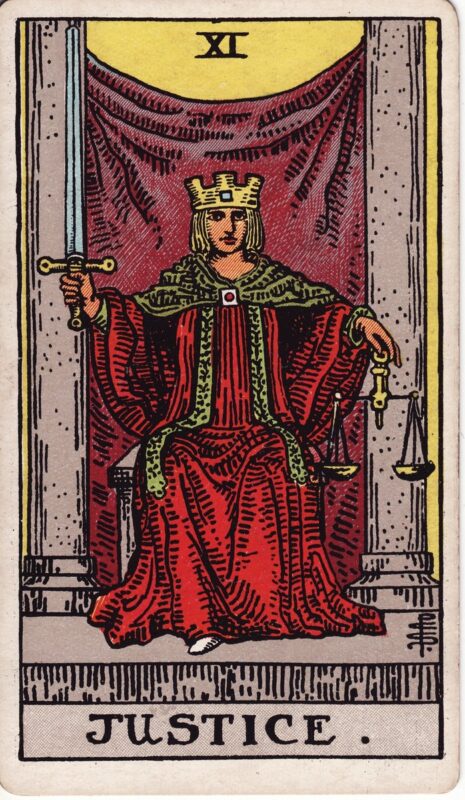
The Justice card shows a crowned figure in a red robe seated between two gray pillars, holding an upright sword in the right hand and a pair of golden scales in the left. The best-known version is the one Pamela Colman Smith painted for the Rider-Waite-Smith tarot, first published in London in December 1909.
Arthur Edward Waite wrote very little about this card in his 1910 book, The Pictorial Key to the Tarot, because, as he put it, it "follows the traditional symbolism and carries above all its obvious meanings." He did point out that "the figure is seated between pillars, like the High Priestess." Here's what each part of the picture is read as:
- The golden scales are read as weighing every side of a matter fairly before making a decision. They're the oldest symbol of justice on the card.
- The upright sword is read as clear thinking and a decision that cuts cleanly through confusion. Because it points straight up, many readers take it as a sign that the outcome will be firm.
- The two pillars are read as the structure of law and order. Waite compared them to the pillars behind the High Priestess, writing that "the pillars of Justice open into one world and the pillars of the High Priestess into another."
- The purple veil hung between the pillars is read as what's still hidden behind a decision, the part of a situation that only comes clear with time.
- The crown with its square jewel is read as authority and a clear, orderly mind.
- The red robe and green cape are read as action and growth, the practical results that come out of fair choices.
Justice Upright Meaning
Justice upright is read as a time when the truth comes out and choices bring the results they've earned. It often turns up when you're facing an important decision, signing an agreement, or waiting to hear how something will be settled. Waite's own meanings for the card were "equity, rightness, probity, executive; triumph of the deserving side in law."
Many readers also read Justice as a reminder that you're responsible for your part in a situation. It asks you to be honest with yourself about what you did, what you didn't do, and what comes next.
Justice Upright in Love
In love, Justice upright is read as a fair, honest relationship where both people pull their weight. For someone single, it's often read as a sign to look for a partner whose values match yours. For a couple, it's read as an honest conversation that clears the air, or a time to make a serious decision together.
Justice Upright in Work and Money
In work, Justice upright is read as being treated fairly, getting the credit you've earned, or signing a contract on good terms. With money, it's read as keeping careful records, paying what you owe, and making choices you can stand behind.
Justice Upright in Spirituality
Spiritually, Justice upright is read as living by your values, and as the idea that what you put into the world comes back to you. It's read as a good time to look honestly at your own choices.
Justice Reversed Meaning
Justice reversed is read as fairness slipping. It often points to a decision that feels one-sided, someone who won't take responsibility for their part, or a situation where the full truth hasn't come out yet. It can also be read as being too hard on yourself or someone else.
Waite's own list for the reversed card was "law in all its departments, legal complications, bigotry, bias, excessive severity," so the reversed card has long been tied to delays, red tape, and judgments that go too far.
In a reading, Justice is about symbolism, not legal advice. If you're facing a real court case, a lawyer is the one to ask, not a card.
Justice Reversed in Love
In love, Justice reversed is read as one partner giving much more than the other, blame going back and forth, or a secret that's tipping the balance.
Justice Reversed in Work and Money
In work, Justice reversed is read as being treated unfairly, office politics, or a deal that doesn't add up. With money, it's read as an unexpected bill, a contract with fine print you missed, or a time to double-check the numbers.
Justice Reversed in Spirituality
Spiritually, Justice reversed is read as avoiding a hard truth about yourself, or as judging others more harshly than you judge your own choices.
Justice as Feelings
As feelings, Justice upright is read as someone who sees you clearly and wants to treat you fairly, and who is thinking seriously about where things stand. Reversed, it's read as someone who feels the relationship is out of balance, or who is holding back a judgment they haven't shared.
Is Justice a Yes or No Card?
Justice upright is usually read as a yes when you've acted honestly and fairly, since the card is about getting what you've earned. Reversed, it's usually read as a no, or as "not until the facts are clear."
Where Justice Comes From
Justice is one of the oldest cards in the tarot. It shows the virtue of justice, one of the four cardinal virtues, and its sword and scales were standard symbols of that virtue long before tarot.
- In the Tarot of Marseilles and most early decks, Justice is card number 8 and follows the Chariot.
- In the Rider-Waite-Smith tarot, Justice and Strength trade places, so Justice becomes number 11. The switch matched the astrological correspondences of the Hermetic Order of the Golden Dawn, which link card 8 with Leo and card 11 with Libra. Many decks in the English-speaking world now follow this numbering.
- The figure is often compared to the Queen of Swords, since both hold an upright sword.
- Waite wrote that the woman on the card "is said to be Astræa," the Greek goddess of justice, who carried the same symbols.
Waite also separated the fairness shown on this card from spiritual grace. He described it as "the moral principle which deals unto every man according to his works."
Justice Correspondences
Justice's correspondences come from its place in the Major Arcana and its astrological link:
| Justice | |
|---|---|
| Number | 11 (XI) in the Rider-Waite-Smith tarot, 8 (VIII) in older decks |
| Arcana | Major Arcana |
| Zodiac sign | Libra |
| Planet | Venus, the ruler of Libra |
| Element | Air, the element of Libra |
In astrology, the Justice card is associated with Libra, the sign of the scales, and with the planet Venus.
How to Work With Justice
Justice is a good card to work with whenever you're weighing a decision and want to see it fairly. Many practitioners set it on the altar before a big choice, or when they want to look honestly at their own part in a situation. Here's a simple practice for a clear, fair decision.
You'll need:
- The Justice card from your deck, such as the Gold Rider-Waite tarot deck
- A white or ivory candle in a heatproof holder, such as an ivory chime candle
- Two slips of paper and a pen
- A lighter or matches
- Set the Justice card upright where you can see it, and light the candle in front of it.
- On one slip of paper, write the reasons for one choice. On the other slip, write the reasons for the other choice, or the reasons against the first.
- Hold one slip in each hand, palms up like the two pans of the scales, and read each one aloud.
- Close your eyes, notice which hand feels heavier to you, and recite:
Even scales and steady hand,
Help me see where I should stand. - Add anything you left off either slip, since the truth you'd rather not write down often matters most.
- Set both slips under the card, let the candle burn down safely or snuff it out, and come back to the slips the next day before you decide.
Never leave a burning candle unattended.
If you keep a tarot journal, Justice is a good card to write about when you pull it. A few prompts to try:
- What decision am I weighing right now, and what am I leaving out?
- Where do I need to take responsibility, and where am I carrying blame that isn't mine?
- What would a fair outcome look like for everyone involved?
Our guide to keeping a tarot journal has a free printable page for it. Justice pairs well with the King of Swords, another card of fair judgment, and with Temperance, its fellow virtue. For the meanings of all 78 cards in one place, see our guide to tarot card meanings.
Justice Tarot Card FAQ
What does the Justice tarot card mean?
Justice is the tarot card of fairness, truth, and cause and effect. Upright, it's read as honesty, accountability, and a fair outcome. Reversed, it's read as unfairness, bias, or dodging responsibility.
What does Justice reversed mean?
Justice reversed is read as fairness slipping, such as a one-sided decision, someone avoiding responsibility, or a situation where the full truth hasn't come out.
Is Justice a yes or no card?
Justice upright is usually read as a yes when you've acted honestly and fairly. Reversed, it's usually read as a no, or "not until the facts are clear."
What does Justice mean in love?
In love, Justice upright is read as a fair, honest relationship where both people pull their weight. Reversed, it's read as an imbalance, blame, or a secret tipping the scales.
What zodiac sign is the Justice card?
The Justice card is associated with Libra, the sign of the scales, and with Libra's ruling planet, Venus.
Why is Justice number 11 in some decks and 8 in others?
Justice was card 8 in older decks such as the Tarot of Marseilles. The Rider-Waite-Smith tarot swapped it with Strength to match the Golden Dawn's astrological correspondences, which link card 11 with Libra.
What do the scales and sword on the Justice card mean?
The scales are read as weighing every side of a matter fairly, and the upright sword is read as a clear, firm decision that cuts through confusion.
Does the Justice card predict how a court case will go?
Justice is read as a card of fairness and truth, not a forecast of a legal outcome. If you're facing a real court case, a lawyer is the one to ask, not a card.