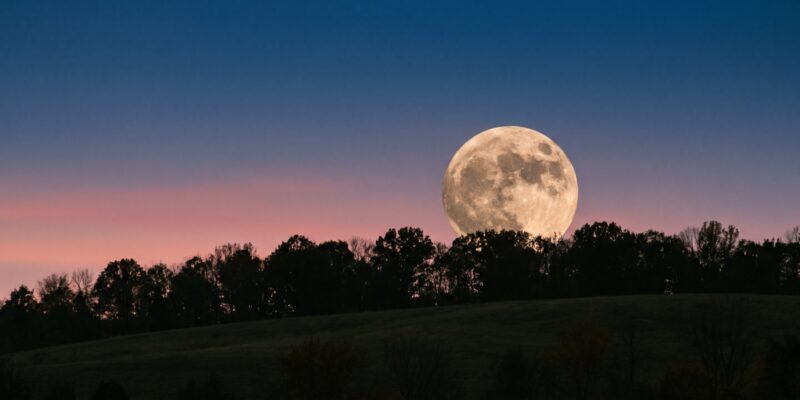
Full moon names are the traditional names given to each month's full moon, like the Wolf Moon in January, the Strawberry Moon in June and the Cold Moon in December. Most of the names used in North America today come from old farmers' almanacs and are tied to what was happening in nature that month. The next full moon is the Hunter's Moon on Monday, October 26, 2026, followed by the Beaver Moon on November 24, which is also a supermoon.
Full Moon Names by Month
Each month's full moon takes the name of the month it falls in, so the name stays the same from year to year even though the date changes.
| Month | Full moon name | Other names | Named for |
|---|---|---|---|
| January | Wolf Moon | Moon After Yule, Ice Moon | Wolves heard howling in the deep of winter |
| February | Snow Moon | Hunger Moon, Storm Moon | The heaviest snows of the year |
| March | Worm Moon | Sap Moon, Lenten Moon | Earthworms appearing as the ground thaws |
| April | Pink Moon | Egg Moon, Sprouting Grass Moon | Pink wild phlox, one of the first spring flowers |
| May | Flower Moon | Milk Moon, Planting Moon | Flowers blooming everywhere |
| June | Strawberry Moon | Rose Moon, Honey Moon | The short strawberry harvest |
| July | Buck Moon | Hay Moon, Thunder Moon | New antlers growing on male deer |
| August | Sturgeon Moon | Grain Moon, Green Corn Moon | Sturgeon running in the Great Lakes |
| September | Harvest Moon | Corn Moon, Barley Moon | Bright moonlight for bringing in the crops |
| October | Hunter's Moon | Travel Moon, Blood Moon | Hunting and storing meat before winter |
| November | Beaver Moon | Frost Moon, Mourning Moon | Beavers building their winter lodges |
| December | Cold Moon | Long Night Moon, Moon Before Yule | The long, cold nights near the winter solstice |
The Harvest Moon is the exception to the month rule. It is the full moon closest to the autumn equinox on September 22 or 23, so in some years it falls in October, and that year's September full moon is called the Corn Moon instead.
What Each Full Moon Is Named For
Here is the story behind each name, what many practitioners like to work on under that moon, and its next date.
January: Wolf Moon
The Wolf Moon is named for the wolves people heard howling during the long nights of midwinter, and older almanacs also call it the Moon After Yule. Many practitioners use it for protection spells, family and close friendships, and finding inner strength in the coldest part of the year. Next Wolf Moon: Friday, January 22, 2027, 7:17 AM ET, a supermoon.
February: Snow Moon
The Snow Moon is named for February's heavy snowfall, and the Hunger Moon name comes from the time of year when stored food ran low. It suits rest, cleansing and quiet planning for spring. Next Snow Moon: Saturday, February 20, 2027, 6:23 PM ET, also a supermoon. A full moon over snow is also the brightest night of winter for gathering snow water.
March: Worm Moon
The Worm Moon is named for the earthworms that show up as the ground thaws, a sign that spring is close. It is a good moon for new beginnings, clearing out winter clutter and planning a garden; our moon phase gardening calendar picks up from there. Next Worm Moon: Monday, March 22, 2027, 6:44 AM ET.
April: Pink Moon
The Pink Moon does not turn pink. It is named for moss phlox, a pink wildflower native to the eastern and central United States that blooms in early spring. Many practitioners use it for growth, self-love and fresh starts. Next Pink Moon: Tuesday, April 20, 2027, 6:27 PM ET.
May: Flower Moon
The Flower Moon is named for the flowers blooming everywhere by late spring. It is a favorite for beauty, love, fertility of all kinds and abundance spells, and for gathering flowers to dry for later work. Next Flower Moon: Thursday, May 20, 2027, 6:59 AM ET, which is also a seasonal blue moon.
June: Strawberry Moon
The Strawberry Moon is named for the short season when wild strawberries ripen. It suits love, friendship, gratitude and sweetening spells, and it often falls close to the summer solstice. Next Strawberry Moon: Friday, June 18, 2027, 8:44 PM ET.
July: Buck Moon
The Buck Moon is named for the new antlers that male deer grow in early summer. Many practitioners use it for confidence, courage and steady progress toward a goal. Next Buck Moon: Sunday, July 18, 2027, 11:45 AM ET.
August: Sturgeon Moon
The Sturgeon Moon is named for the large sturgeon that were easiest to catch in the Great Lakes and nearby lakes in late summer. It suits patience, persistence and money spells that build slowly. Next Sturgeon Moon: Tuesday, August 17, 2027, 3:29 AM ET.
September: Harvest Moon
The Harvest Moon is the full moon closest to the autumn equinox. For several nights around it, the Moon rises soon after sunset, which once gave farmers extra light to bring in the crops. It is a natural time for gratitude, sharing food and gathering herbs; see our Harvest Moon guide for ideas. Next Harvest Moon: Wednesday, September 15, 2027, 7:03 PM ET.
October: Hunter's Moon
The Hunter's Moon is the full moon after the Harvest Moon, named for the hunting and storing of meat before winter. It falls close to Samhain, so many practitioners use it for protection, honoring ancestors and getting ready for the dark half of the year. Next Hunter's Moon: Monday, October 26, 2026, 12:12 AM ET, late on the night of October 25.
November: Beaver Moon
The Beaver Moon is named for the time of year when beavers finish their lodges and settle in for winter, and when trappers set their traps before the water froze. It suits home blessings, finishing projects and preparing for the season ahead. Next Beaver Moon: Tuesday, November 24, 2026, 9:53 AM ET, a supermoon.
December: Cold Moon
The Cold Moon is named for the long, freezing nights of early winter, and it is also called the Long Night Moon because it falls near the winter solstice. Many practitioners use it for rest, reflection and Yule celebrations. Next Cold Moon: Wednesday, December 23, 2026, 8:28 PM ET, the closest supermoon of 2026. Our winter witchcraft guide has more ways to work with the cold season.
Full Moon Dates and Times for 2026 and 2027
The next full moon is the Hunter's Moon on Monday, October 26, 2026, at 12:12 AM Eastern Time, which is late on the night of Sunday, October 25. Here is every full moon through the end of 2027, with its North American name and the sign the Moon is in. Four of them are supermoons, when the Moon is at its closest to Earth. Tap a date to see the whole sky at that moment.
| Full moon (Eastern Time) | Name | Moon sign |
|---|---|---|
| Mon, Oct 26, 2026, 12:12 AM | Hunter's Moon | Taurus |
| Tue, Nov 24, 2026, 9:53 AM | Beaver Moon (supermoon) | Gemini |
| Wed, Dec 23, 2026, 8:28 PM | Cold Moon (supermoon) | Cancer |
| Fri, Jan 22, 2027, 7:17 AM | Wolf Moon (supermoon) | Leo |
| Sat, Feb 20, 2027, 6:23 PM | Snow Moon (supermoon) | Virgo |
| Mon, Mar 22, 2027, 6:44 AM | Worm Moon | Libra |
| Tue, Apr 20, 2027, 6:27 PM | Pink Moon | Scorpio |
| Thu, May 20, 2027, 6:59 AM | Flower Moon | Scorpio |
| Fri, Jun 18, 2027, 8:44 PM | Strawberry Moon | Sagittarius |
| Sun, Jul 18, 2027, 11:45 AM | Buck Moon | Capricorn |
| Tue, Aug 17, 2027, 3:29 AM | Sturgeon Moon | Aquarius |
| Wed, Sep 15, 2027, 7:03 PM | Harvest Moon | Pisces |
| Fri, Oct 15, 2027, 9:47 AM | Hunter's Moon | Aries |
| Sat, Nov 13, 2027, 10:26 PM | Beaver Moon | Taurus |
| Mon, Dec 13, 2027, 11:09 AM | Cold Moon | Gemini |
Times come from the US Naval Observatory and are shown in Eastern Time, so the date can be a day earlier or later where you live. The moon calendar shows the phase for every night of the month.
Where Full Moon Names Come From
The full moon names most people know today were popularized by American farmers' almanacs in the 1900s. The 1937 Maine Farmers' Almanac printed a list it said came from "our early English ancestors," including the Wolf Moon, Harvest Moon and Hunter's Moon, and later almanacs spread the full set (Wikipedia: Full moon).
Some names have older roots. In 1778, the explorer Jonathan Carver recorded a list of lunar months that included Worm, Flower, Buck, Sturgeon, Beaver, Cold and Snow, and the Harvest Moon and Hunter's Moon appear in English writing from the early 1700s.
Almanacs often describe the names as Native American, but the story is more complicated. Many Native nations do have their own names for the moons of the year, and they differ from nation to nation and region to region. Those names and their meanings are best learned from people within each nation, who share them on their own terms.
Special Full Moons: Blue, Blood, Harvest and Supermoons
A few full moons get extra names because of when or how they happen.
- Blue moon: the second full moon in a calendar month, or by the older rule, the third full moon in a season that has four. The calendar meaning comes from a 1946 magazine article that misread the old almanac rule (Wikipedia: Blue moon). The next seasonal blue moon is the Flower Moon on May 20, 2027, and the next calendar blue moon is December 31, 2028.
- Blood moon: a full moon during a total lunar eclipse, when Earth's shadow turns the Moon a deep red (Wikipedia: Lunar eclipse). The name is also an old nickname for the Hunter's Moon. The next total lunar eclipse is December 31, 2028, and it happens during daytime in North America.
- Supermoon: a full moon at or near the Moon's closest point to Earth. The next four are November 24 and December 23, 2026, and January 22 and February 20, 2027. Our supermoon guide has the details.
- Harvest Moon: the full moon closest to the autumn equinox, which can fall in September or October.
Full Moon Names in the Southern Hemisphere
In the Southern Hemisphere, the seasons are flipped, so many people there shift the names by six months to match what is happening outside. That makes the Wolf Moon a July full moon, and the Strawberry Moon a December one.
| Month | Southern Hemisphere name |
|---|---|
| January | Buck Moon |
| February | Sturgeon Moon |
| March | Harvest Moon |
| April | Hunter's Moon |
| May | Beaver Moon |
| June | Cold Moon |
| July | Wolf Moon |
| August | Snow Moon |
| September | Worm Moon |
| October | Pink Moon |
| November | Flower Moon |
| December | Strawberry Moon |
How to Work With Any Full Moon
Whatever its name, every full moon is traditionally a time for gratitude, release and charging your tools. Many practitioners make moon water, set crystals in the moonlight, or write down what they are ready to let go of. For more ideas, see 13 things to do during a full moon, and use the moon calendar to see each night's phase and sign.
Full Moon Names FAQ
What is this month's full moon called?
Each month has its own full moon name, listed in the table at the top of this page. In 2026, October's full moon is the Hunter's Moon on October 26, November's is the Beaver Moon on November 24, and December's is the Cold Moon on December 23.
Why do full moons have names?
Full moons were named to keep track of the seasons. Each name points to something happening in nature that month, like snow in February or ripe strawberries in June.
What is the full moon in November called?
The November full moon is called the Beaver Moon. In 2026 it falls on Tuesday, November 24, at 9:53 AM Eastern Time, and it is also a supermoon.
What is the Beaver Moon named for?
The Beaver Moon is named for the time of year when beavers finish building their winter lodges, and when trappers once set their traps before the rivers froze.
What is the difference between the Harvest Moon and the Hunter's Moon?
The Harvest Moon is the full moon closest to the autumn equinox, and the Hunter's Moon is the full moon right after it. In 2026, the Harvest Moon was September 26 and the Hunter's Moon is October 26.
When is the next blue moon?
The next blue moon by the seasonal rule is May 20, 2027. The next blue moon by the calendar rule, the second full moon in one month, is December 31, 2028.
What is a blood moon?
A blood moon is a full moon during a total lunar eclipse, when the Moon turns red in Earth's shadow. The next total lunar eclipse is December 31, 2028.
Are full moon names Native American?
Some are linked to Native American traditions, but the list most people use today was popularized by American farmers' almanacs. Native nations have their own moon names, which vary by nation and are best learned from the nations themselves.
Do full moon names change in the Southern Hemisphere?
Many people in the Southern Hemisphere shift the names by six months to match their seasons, so January's full moon there is often called the Buck Moon.