The Cailleach is the divine hag of Gaelic folklore, an ancient winter goddess of Scotland, Ireland, and the Isle of Man who raises the storms, freezes the ground with her staff, and shaped the mountains with her own hands. In the old Gaelic year she rules from Samhain to Beltane, the whole dark half of the year. Below you'll find what her name means, the stories told about her, the places across Scotland and Ireland that carry her name, and how to say Cailleach.
Who Is the Cailleach?
The Cailleach is a divine hag of Irish, Scottish, and Manx myth, tied to the creation of the land and to the weather, especially winter and storms. She's usually pictured as an old woman of enormous size and strength who strides across the hills.
She shows up as a personification of winter itself. In the old stories she herds the deer, fights against the coming of spring, and freezes the earth wherever she strikes it with her staff. She's also a maker: mountains and hills are said to have formed when she dropped rocks from the wicker basket she carried on her back, and she shapes the valleys with a hammer.
What Does Cailleach Mean?
Cailleach means "old woman" or "hag" in Irish and Scottish Gaelic, and people still use it that way today. The word comes from the Old Irish caillech, "veiled one," from caille, "veil," which was borrowed long ago from the Latin pallium, a woolen cloak.
The word turns up in some telling places. A cailleach feasa is a wise woman or fortune-teller, a cailleach phiseogach is a sorceress or charm-worker, and a cailleach-oidhche is an owl. In Lowland Scots, the related word carline means an old woman or a witch.
She goes by several names. In Ireland she's often the Cailleach Bhéarra, the Hag of Beara, after the Beara Peninsula in the southwest. In Scottish Gaelic she's the Cailleach Bheurra, and on the Isle of Man she's the Caillagh.
How Do You Pronounce Cailleach?
You pronounce Cailleach roughly "KAL-yakh," with the "kh" made in the back of the throat like the "ch" in the Scottish word loch. Irish speakers say something close to "KAL-yukh," and some put the stress on the second syllable, "kuh-LYAKH."
The Cailleach and Brìghde: Winter and Summer
The Cailleach rules the winter half of the year, from Samhain to Beltane, and the goddess Brìghde rules the summer half, from Beltane back to Samhain. Some tellings say the two are two faces of the same goddess. Others say the Cailleach turns to stone at Beltane and wakes again at Samhain, just in time to take back the winter.
The handover from winter to spring is celebrated at different times depending on how cold a place is: as early as Imbolc on February 1, on Latha na Cailliche, "the Old Woman's Day," on March 25, or as late as Beltane on May 1.
For more on the festivals at each end of her reign, see our guides to what Samhain is and the Wheel of the Year.
The Cailleach's Imbolc Weather Lore
On Imbolc, February 1, the Cailleach goes out to gather the firewood she'll need for the rest of winter, and the weather that day tells you how long winter will last. If she wants the winter to drag on, she makes sure February 1 is bright and sunny so she can collect plenty of wood. If the day is stormy and gray, she's asleep and will soon run out of firewood, which means spring is close.
So in the Highlands, a miserable Imbolc was good news. On the Isle of Man, people said the Cailleach could be seen on St. Bride's Day in the shape of a giant bird, carrying sticks in her beak. Our Imbolc guide covers the rest of the festival.
Beira, Queen of Winter
Beira, Queen of Winter, is the Scottish Cailleach as retold by the 20th-century folklorist Donald A. Mackenzie. The name Beira comes from his books, along with her best-known description: a one-eyed giantess with white hair, dark blue skin, and rust-colored teeth.
Mackenzie also tells one of the loveliest Cailleach stories. On the longest night of the year, the old Queen of Winter visits the Well of Youth, drinks its magic water, and begins to grow younger day by day. It's a beautiful picture of the winter solstice, but it's his retelling, so it's best shared as Mackenzie's version rather than ancient lore.
The Storm Hags and the Whirlpool of Corryvreckan
The Cailleach brings winter to the west coast of Scotland by washing her great plaid in the Gulf of Corryvreckan, a famous whirlpool between the islands of Jura and Scarba. The washing takes three days, and the roar of the coming storm can be heard 20 miles inland. When she lifts the plaid out, it's pure white, and snow covers the land.

In Scotland, the Cailleachan, "old women," are also the Storm Hags, the wild powers of nature at their most destructive. They're said to be busiest in the windstorms of early spring, a stretch of weather called A' Chailleach.
The Cailleach in the Harvest
The Cailleach also appears at harvest time as a corn dolly. In Scotland and Ireland, the first farmer to finish the grain harvest made a figure from the last sheaf, called the Cailleach or the Carline, and tossed it into the field of a neighbor who wasn't finished yet. Whoever finished last had to keep the "old woman" all winter, which meant feeding and housing the hag until spring. Nobody wanted to be last.
Places Named for the Cailleach
The Cailleach's name is written across the landscape of Ireland and Scotland, on mountains, cliffs, tombs, and stones. These are a few you can visit:

In Ireland:
- Hag's Head (Ceann Caillí), the southern tip of the Cliffs of Moher in County Clare.
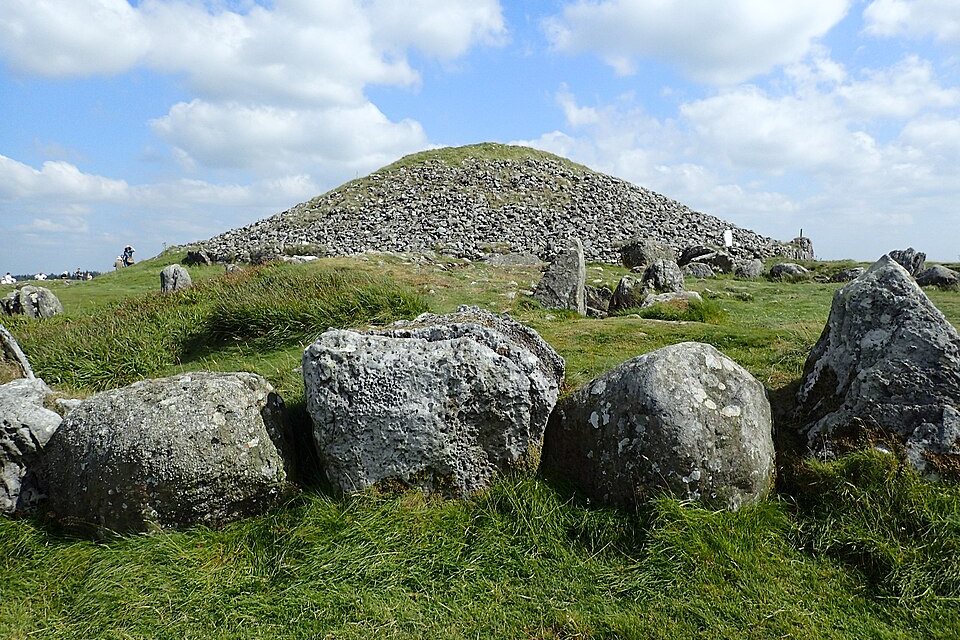
- Loughcrew in County Meath, a group of ancient passage tombs on Slieve na Calliagh, "the hag's mountain," with a kerbstone known as the Hag's Chair. At the equinoxes, sunrise lights up the carved inner chamber of Cairn T.
- Labbacallee (Leaba Chaillí, "the hag's bed"), a wedge tomb in County Cork said to be her grave.
- The Hag of Beara rock at Kilcatherine on the Beara Peninsula in West Cork, a stone said to be the Cailleach herself.
- Slieve Gullion in County Armagh, where the summit passage tomb is known locally as the Calliagh Beara's House.
In Scotland:
- Ben Cruachan in Argyll, where she fell asleep while tending a well and let it overflow, flooding the valley and creating Loch Awe.
- Ben Nevis, said to be her mountain throne.
- Beinn na Caillich on the Isle of Skye, two mountains named for her that send down storms of sleet and rain.
- Tigh nan Cailleach in Glen Lyon, Perthshire, a tiny stone shelter holding water-worn stones said to be the Cailleach, her husband, and their children. Every Beltane the stones are set outside to look over the glen, and every Samhain they're tucked back in for the winter, a custom that's still kept today.
Symbols of the Cailleach
The Cailleach's symbols come straight from her stories:
- The staff, which freezes the ground.
- The hammer, for shaping hills and valleys.
- The creel, the wicker basket of rocks that became mountains.
- Deer, which she herds through the winter.
- The plaid, which she washes white with snow.
- Stones and mountains, where she rests, turns to stone, or is said to live.
- Storms and winter weather, her signature.
How to Honor the Cailleach in Winter
Many modern Pagans and witches honor the Cailleach as a goddess of winter, wisdom, and old age. These are modern ideas inspired by her stories, not Gaelic customs:
- Welcome her at Samhain. Set a smooth stone on your altar when winter begins and put it away at Beltane, a small echo of the Glen Lyon stones.
- Watch the weather on Imbolc. Note whether February 1 is bright or stormy, and see whether her forecast holds.
- Rest with the season. The Cailleach rules the dark half of the year. Winter is a natural time to slow down, finish old work, and let things lie fallow.
- Honor the elders in your life. The Cailleach is the wise old woman. Visit, call, or write to an older person you love, and listen to their stories.
- Tell her stories by the fire. Her tales of mountains, whirlpools, and storms are perfect for long winter nights, alongside other winter visitors like Iceland's Yule Cat.
For more winter goddesses and seasonal magic, see our guide to winter witchcraft, and for the festival at the heart of her season, what Yule is.
Frequently Asked Questions About the Cailleach
What Is the Cailleach the Goddess Of?
The Cailleach is the goddess of winter, storms, and the land in Gaelic folklore. She rules the dark half of the year from Samhain to Beltane and is said to have shaped the mountains.
Is the Cailleach a Witch?
The Cailleach is usually described as a divine hag or goddess rather than a witch, but her name is closely tied to Gaelic words for wise women and charm-workers. In Lowland Scots, the related word carline means an old woman or witch.
Is the Cailleach Scottish or Irish?
The Cailleach is both Scottish and Irish, and she's known on the Isle of Man too. Places across Ireland and Scotland carry her name, from Hag's Head in County Clare to Ben Cruachan in Argyll.
What Is the Difference Between the Cailleach and Beira?
Beira is a name for the Scottish Cailleach that comes from the 20th-century folklorist Donald A. Mackenzie. The Cailleach is the older figure, and Beira, Queen of Winter, is his retelling of her.
What Does the Cailleach Do on Imbolc?
On Imbolc, February 1, the Cailleach gathers firewood for the rest of winter. A bright, sunny day means she's collecting plenty and winter will last longer, while a stormy day means she's asleep and spring is near.
When Does the Cailleach Rule?
The Cailleach rules from Samhain, the start of winter, to Beltane on May 1. The goddess Brìghde rules the summer half of the year.
Featured photo: Ben Cruachan by Kognos, CC BY-SA 4.0, via Wikimedia Commons, cropped.