Snowflake obsidian is black volcanic glass scattered with soft white spots that look like snowflakes. The "snowflakes" are tiny clusters of a white mineral called cristobalite, which form as the glass very slowly begins to crystallize. In crystal practice, snowflake obsidian is the gentle obsidian. Practitioners use it for balance, honest self-reflection, grounding, and steady protection through hard seasons, and many reach for it when plain black obsidian feels too intense.
What Is Snowflake Obsidian?
Snowflake obsidian is natural obsidian, a volcanic glass, that contains small white spherulites of cristobalite. Obsidian forms when lava rich in silica cools so quickly that it hardens into glass instead of growing crystals. In some obsidian, small, white, radially clustered crystals of cristobalite form inside the black glass, and those clusters make the blotchy, snowflake pattern the stone is named for.
Nothing is painted or added. The white patches are part of the stone, and each piece has its own scatter of flakes.
How Snowflake Obsidian Forms
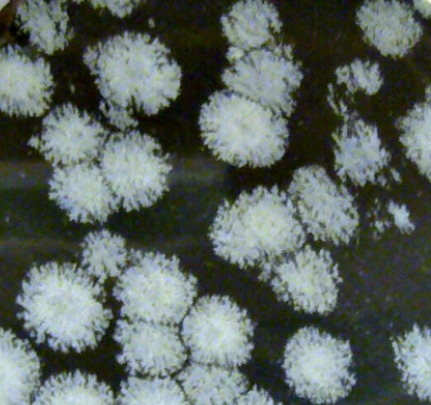
Snowflake obsidian forms when volcanic glass slowly begins turning back into crystals, a process geologists call devitrification. Obsidian isn't stable at the Earth's surface over long stretches of time. Little by little, the glass starts to crystallize, and cristobalite is usually the first mineral to form when silica glass does this. Water speeds the change up. That's also why truly ancient obsidian is rare: given enough time, the glass turns into other rock.
One well-known source is the Black Rock Desert of Millard County in western Utah. According to the Utah Geological Survey, volcanic eruptions there about 2.5 million years ago produced rhyolite, pumice, and obsidian, and snowflake obsidian with whitish-gray spherulites of needle-shaped cristobalite crystals can be found on the ground today.
Is Snowflake Obsidian Rare?
No, snowflake obsidian isn't rare. It's one of the most common and affordable crystals in shops, sold as tumbled stones, beads, spheres, and carvings. Larger pieces with crisp, evenly spaced flakes and a high polish cost more, but even those are modestly priced next to most gemstones.
Snowflake Obsidian vs Black Obsidian
Snowflake obsidian and black obsidian are the same volcanic glass. Black obsidian is solid black, while snowflake obsidian has white cristobalite spots where the glass has started to crystallize.
In crystal practice they behave differently. Black obsidian is the intense one, used for strong protection, cutting cords, and scrying. Snowflake obsidian is calmer and more reflective, with the white against the black often read as balance: the light inside the dark. Our black obsidian guide covers the plain black stone and the other obsidian varieties.
Red and Other Colors of Snowflake Obsidian
Most snowflake obsidian is black with white or gray flakes, but reddish-brown obsidian with flakes is sometimes sold as red snowflake obsidian. The Utah Geological Survey notes that reddish-brown obsidian turns up alongside the black and snowflake kinds in the Black Rock Desert. Bright blue, green, or other vivid colors sold as "snowflake obsidian" are worth questioning, since natural obsidian is almost always black, brown, or gray.
Snowflake Obsidian Spiritual Meaning
The spiritual meaning of snowflake obsidian is balance, honest self-reflection, and gentle protection. The white flakes in the black glass are read as light within darkness, so it's the stone many practitioners choose when they want to look at their patterns, habits, and mistakes clearly, without the heaviness black obsidian can bring.
In crystal practice, snowflake obsidian is known as a calming stone of balance, one that helps you value your mistakes as well as your successes. It's the stone for seeing yourself honestly and kindly at the same time.
It also has a seasonal meaning. With its snow-on-black look, snowflake obsidian is a favorite winter stone, kept on the altar from the first frost to the thaw. Our guide to winter witchcraft lists it with the season's other correspondences.
What Is Snowflake Obsidian Good For?
In crystal practice, snowflake obsidian is good for balance, self-reflection, and grounding. Here's how practitioners use it most:
- Shadow work: Many people hold it while journaling about the habits and fears they'd rather not look at.
- Balance: The light-in-dark pattern makes it a stone for evening out a life that feels tipped too far one way.
- Learning from mistakes: It's often kept nearby when someone is trying to break a pattern and wants to see it clearly.
- Grounding: Like all obsidian, it's a root chakra stone for feeling steady and present.
- Gentle protection: It's a softer protection stone than black obsidian, often carried through a long, hard season.
- Winter practice: It's a natural fit for winter altars and solstice work.
Snowflake Obsidian Properties and Correspondences
Snowflake obsidian's main correspondences are the root chakra, the element of Earth, and the planet Saturn. Here are its physical and magical properties together:
- What it is: It's natural volcanic glass with white spherulites of cristobalite. Obsidian is a mineraloid, not a mineral, because it has no crystal structure of its own.
- Hardness: It's 5 to 6 on the Mohs scale, so it's softer than quartz and can chip.
- Colors: It's black with white or gray flakes, and occasionally reddish-brown with flakes.
- Chakra: It belongs to the root chakra.
- Element: Most modern books give Earth for its grounding. Scott Cunningham gave obsidian as a whole the element of Fire.
- Planet: Saturn, the planet of structure, limits, and lessons, is the traditional planet for obsidian.
- Magical uses: It's used for balance, self-reflection, grounding, protection, and endurance.
- Season: It's a winter stone, for the cold half of the year.
Snowflake Obsidian Chakra
Snowflake obsidian is a root chakra stone. The root chakra, at the base of the spine, is the energy center tied to safety, stability, and feeling at home in your body, and obsidian's grounding weight belongs there. Some practitioners also place it at the third eye during meditation for clear insight. Our complete list of chakra crystals includes the other root chakra stones.
How to Use Snowflake Obsidian
You can use snowflake obsidian by carrying it, wearing it, keeping it on your altar, or holding it during meditation and journaling. Here are the most common ways to work with it:
- Carry a tumbled stone in your pocket through a hard week, and hold it when you need to feel steady.
- Hold it while you journal about a pattern you want to change. Many people keep one on their Book of Shadows while they write.
- Set it on a winter altar with white candles, pine, and a bowl of snow water.
- Keep one by the front door as gentle protection for the home.
- Place one under your pillow or on the nightstand if you're doing dreamwork during the long winter nights.
- Add it to a crystal grid for balance, with clear quartz to bring in light.
A Snowflake Obsidian Ritual for Seeing Your Patterns
This short ritual uses snowflake obsidian to help you look honestly at one pattern in your life. It works well on a new moon or a winter evening.
You'll need: a snowflake obsidian stone, a white candle, paper, and a pen.
- Light the white candle and hold the stone in your nondominant hand.
- Look at the white flakes in the black glass for a minute, and let your breathing slow.
- Write down one pattern you keep repeating, such as a habit, a reaction, or a choice.
- Under it, write one thing that pattern has taught you.
- Hold the stone over the paper and recite these words:
White in the black and light in the night,
show me my patterns plainly and right.
What I have learned, I'll carry with grace,
and what I'm done with, I'll leave in its place.
- Fold the paper and keep it under the stone on your altar until the next full moon. Then read it again and notice what has changed.
Crystals That Pair Well With Snowflake Obsidian
Snowflake obsidian pairs best with stones that add warmth, light, or extra grounding. These are common pairings:
- Clear quartz brings light to whatever snowflake obsidian helps you see.
- Rose quartz adds gentleness to shadow work.
- Black obsidian strengthens protection when you need the sharper stone.
- Selenite keeps the white-and-light theme for winter altars and cleanses the other stones.
- Garnet adds warmth and steady energy in the dark months.
- Moonstone suits dreamwork and new moon reflection.
Snowflake Obsidian Bracelet: How to Wear It
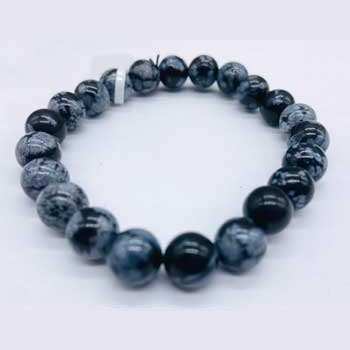
A snowflake obsidian bracelet keeps the stone with you all day, which suits its steadying, grounding role. Many practitioners wear grounding and protection stones on the left wrist, the receiving side, though either wrist is fine.
Because obsidian is glass, take the bracelet off before heavy work, the gym, or anything where it might knock against a hard surface. A chipped bead can be sharp. Our 8mm snowflake obsidian bracelet and stretch bracelet both show the flakes on every bead.
How to Cleanse and Charge Snowflake Obsidian
You can cleanse snowflake obsidian with water, smoke, sound, moonlight, or a selenite plate, since it's non-porous glass that's safe in water. Here are the easiest methods:
- Water: Rinse it under cool running water and dry it with a soft cloth.
- Smoke: Pass it through incense or herb smoke.
- Sound: Ring a bell or singing bowl over it.
- Moonlight: Leave it on a windowsill overnight, especially on a new moon.
- Selenite: Set it on a selenite plate overnight, but keep the selenite itself dry.
- Snow: In winter, you can set it in a bowl of fresh snow overnight and let the snow melt around it.
To charge it, hold it, name what you want it to help with in plain words, and keep it where it can do that job. Our Crystal Care Checker shows which of your other stones are safe in water, salt, and sun.
How to Tell if Snowflake Obsidian Is Real
Most snowflake obsidian is real, because the natural stone is common and inexpensive, so there's little reason to fake it. Real snowflake obsidian has irregular gray-white flakes of different sizes, scattered unevenly through the black glass, and each bead or stone has its own pattern. Flakes that look perfectly identical from piece to piece, or bright, unnatural colors, are worth a closer look. Obsidian is also cool to the touch and breaks with smooth, curved, shell-like edges, the way glass does.
How Much Is Snowflake Obsidian Worth?
Snowflake obsidian is inexpensive. Small tumbled stones usually cost a few dollars each, bracelets cost about $5 to $20, and larger polished pieces like spheres and carvings cost more depending on size, polish, and how crisp the flakes are. In our shop, the bracelets start at $4.95, and tumbled stones by the pound start at $23.95.
Snowflake Obsidian Care
Snowflake obsidian is fairly easy to care for, but it's glass, so it can scratch and chip. Store it apart from harder stones like quartz, which can scratch it, and keep it off hard floors and countertops where it might fall. It's safe in water and won't fade in sunlight. If a piece chips and leaves a sharp edge, handle it carefully, since obsidian edges can be very sharp.
Where to Find Snowflake Obsidian
You can find snowflake obsidian at most crystal shops and metaphysical stores. Our snowflake obsidian collection has tumbled stones by the pound, larger tumbled pebbles, and bracelets, and snowflake obsidian is one of the five stones in our Purification Gemstone Kit.
Snowflake Obsidian FAQ
What is snowflake obsidian?
Snowflake obsidian is natural volcanic glass with small white clusters of cristobalite, a form of silica, scattered through it. The white clusters look like snowflakes against the black glass, which gives the stone its name.
What is snowflake obsidian good for?
In crystal practice, snowflake obsidian is good for balance, honest self-reflection, grounding, and gentle protection. Many people use it for shadow work and for getting through a hard season steadily.
What is the spiritual meaning of snowflake obsidian?
The spiritual meaning of snowflake obsidian is balance and light within darkness. It's used to look clearly and kindly at your own patterns and mistakes, and to stay grounded while you do.
Is snowflake obsidian natural?
Yes, snowflake obsidian is natural. The white flakes are cristobalite crystals that formed as the volcanic glass slowly began to crystallize, and nothing is added or dyed.
How is snowflake obsidian formed?
Snowflake obsidian forms when lava cools quickly into glass, and then, over a very long time, small parts of that glass begin to crystallize into white cristobalite. Those clusters of crystals are the snowflakes.
Is snowflake obsidian rare?
No, snowflake obsidian is common and affordable. One well-known source is the Black Rock Desert in western Utah.
What chakra is snowflake obsidian?
Snowflake obsidian is a root chakra stone, used for grounding, stability, and feeling safe and present.
Can snowflake obsidian go in water?
Yes, snowflake obsidian can go in water. It's non-porous volcanic glass, so a rinse or soak won't harm it. Dry it afterward with a soft cloth.
How much is snowflake obsidian worth?
Snowflake obsidian is inexpensive. Tumbled stones usually cost a few dollars each and bracelets about $5 to $20, with larger polished pieces costing more.
What is the difference between snowflake obsidian and black obsidian?
They're the same volcanic glass. Black obsidian is solid black, while snowflake obsidian has white cristobalite flakes. In crystal practice, black obsidian is the more intense protection stone, and snowflake obsidian is gentler and more reflective.
Who should wear snowflake obsidian?
Anyone can wear snowflake obsidian. It's especially popular with people doing shadow work, people going through a hard season, and people who find black obsidian too intense.
Snowflake obsidian is a reminder that even the darkest glass is slowly changing, one small white flake at a time. Keep a piece close through the long nights, and let it show you what's already turning to light.
Featured photo: James St. John, CC BY 2.0, via Wikimedia Commons.