The yew tree stands for death and rebirth, eternity, the ancestors, and protection. It's an evergreen that can live for well over a thousand years, and its drooping branches can take root where they touch the ground and grow into new trunks, which is why so many cultures saw the yew as a bridge between life and death. Yews grow in churchyards across Britain and Ireland, they were sacred to Hecate in ancient Greece, and they give their name to the Eihwaz rune. The yew is also one of the most poisonous trees in Europe, so this guide covers how to honor it without handling it.
What Is a Yew Tree?
Yews are slow-growing evergreen conifers in the genus Taxus. The best known is the European yew, Taxus baccata, which North Americans often call English yew (Wikipedia). It grows wild across Europe, from Norway to North Africa and east into Iran, and has been planted around the world as a hedge and garden tree.
The word yew comes from the Old English īw or ēow, related to the Welsh ywen and Old Irish éo. The scientific name Taxus may come from the Greek toxon, "bow," since yew wood made some of history's best bows. Baccata is Latin for "bearing berries."
Yew is extremely shade-tolerant. Under its dark, dense branches, almost nothing else grows, and it can keep photosynthesizing through the winter after the trees around it have dropped their leaves.
How to Identify a Yew Tree
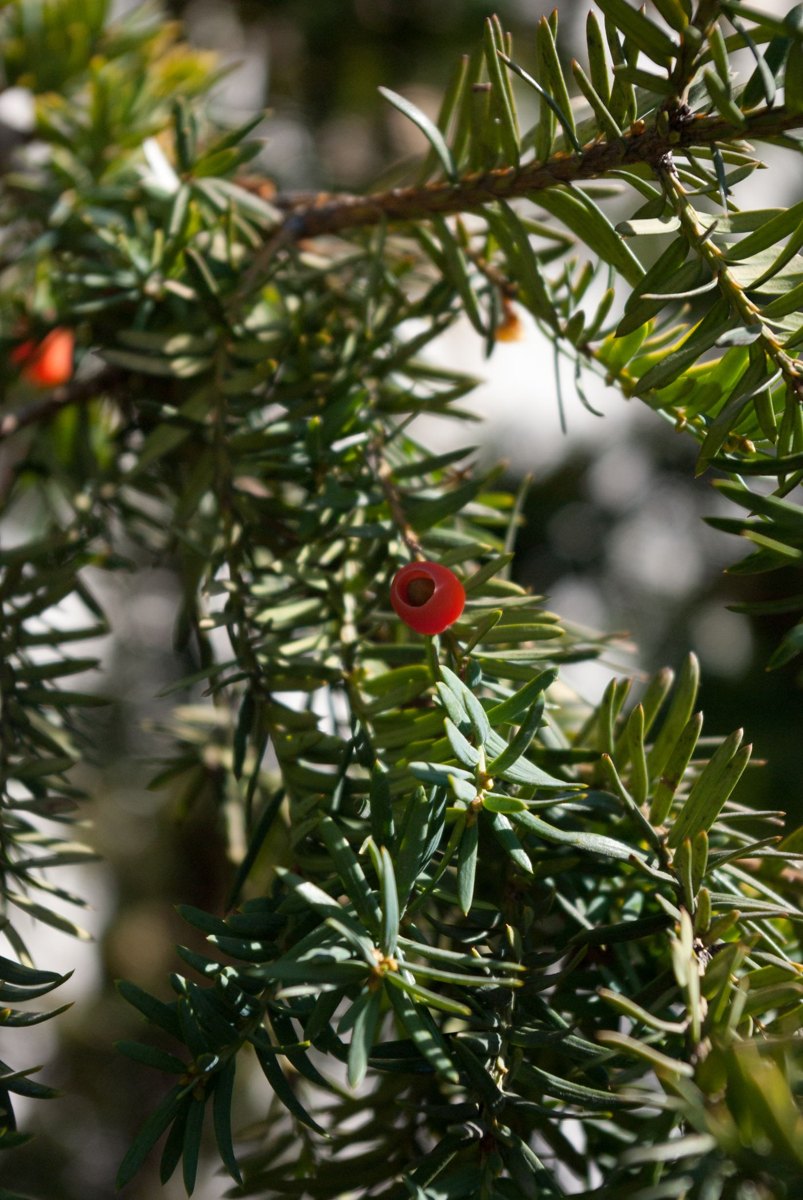
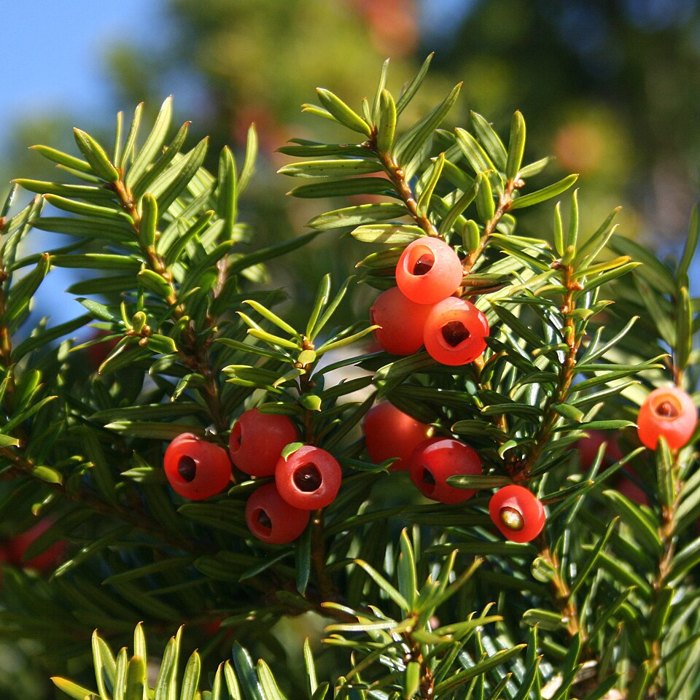
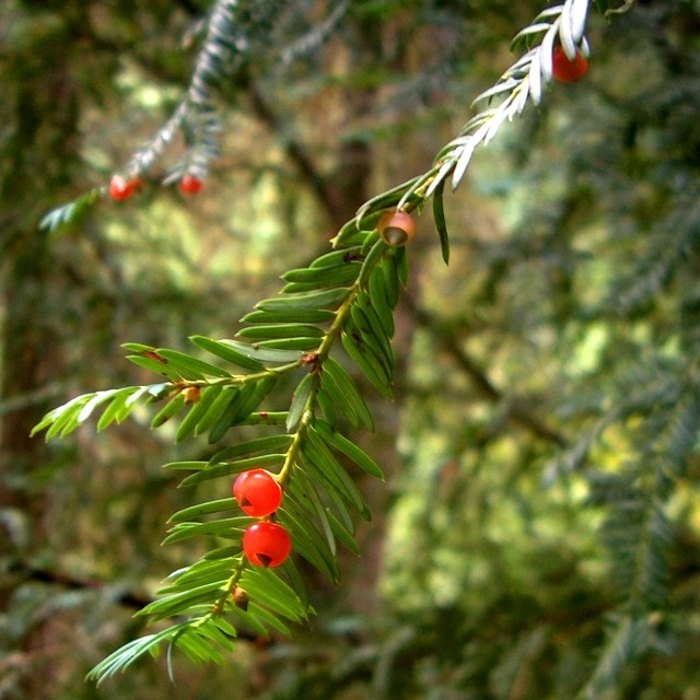
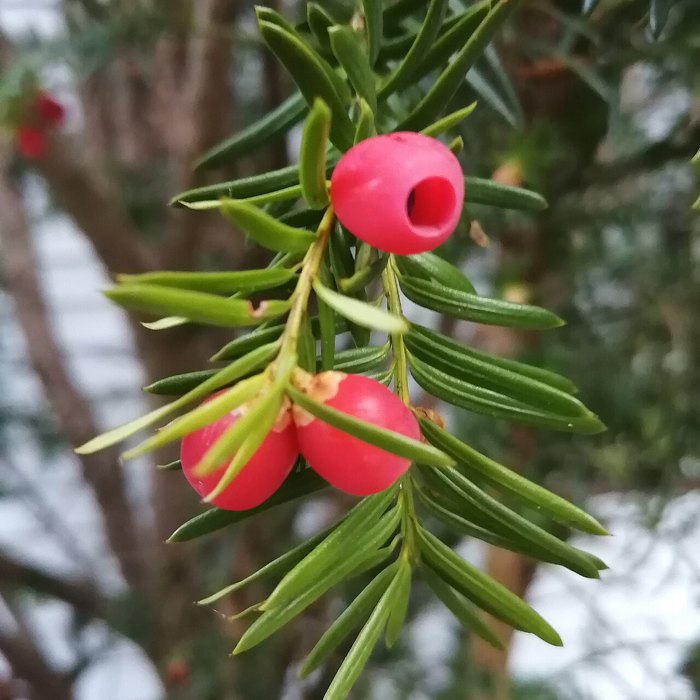
- Needles: flat, dark green, and soft, about ½ to 1½ inches long. They grow in a spiral, but twist at the base to lie in two flat rows along each side of the twig.
- "Berries": a single seed sitting in a soft, bright red cup called an aril, open at one end. Yews don't make cones.
- Bark: thin and reddish-brown, flaking off in small scales.
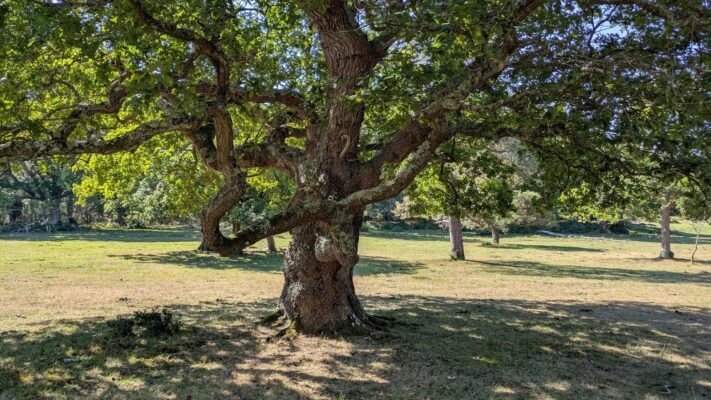
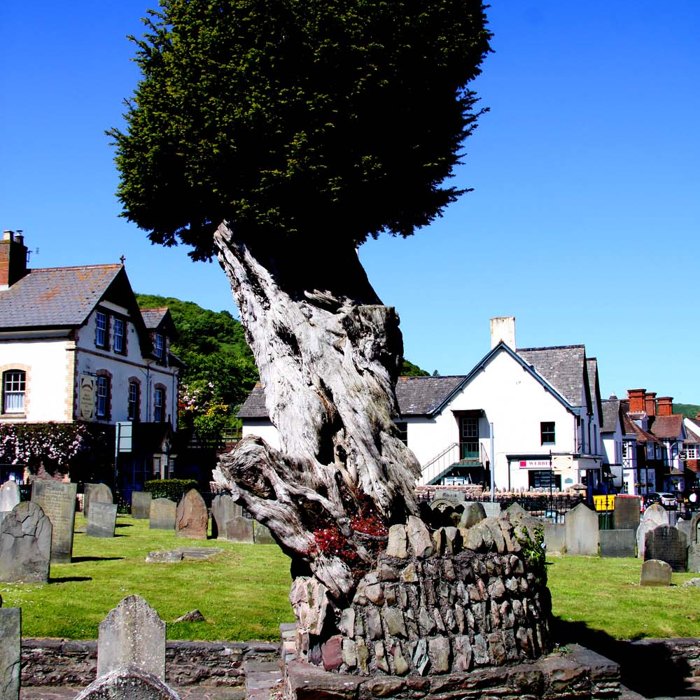
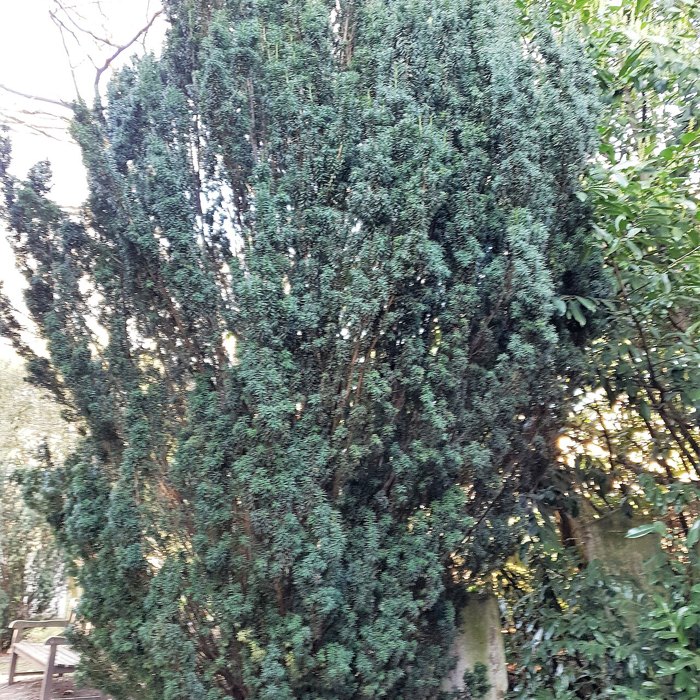
- Shape: a small to medium tree, usually 35 to 65 feet tall, often with a broad, many-stemmed trunk. Old yews are frequently hollow.
- Male and female trees: most yews are either male or female. Only female trees carry the red arils. Male trees shed clouds of pollen in early spring.
A few plants get mistaken for yew. Eastern hemlock (Tsuga canadensis) has similar flat needles in two rows, but it's in the pine family and carries small brown cones (Wikipedia). It isn't related to poison hemlock, a different plant entirely. Yew pine, also called Buddhist pine or podocarpus (Podocarpus macrophyllus), is sold in garden centers as "Japanese yew," but it's in a different family altogether (Wikipedia). Plum-yew (Cephalotaxus) is a close relative from eastern Asia, sometimes counted in the yew family itself (Wikipedia). If you aren't sure what a plant is, treat it as a yew and keep kids and pets away from it.
Types of Yew Trees
- European or English yew (Taxus baccata): the original yew of churchyards and folklore, native to Europe, western Asia, and North Africa (Wikipedia).
- Irish yew (Taxus baccata 'Fastigiata'): a narrow, upright form of the European yew. Every Irish yew is believed to come from cuttings of the original tree at Florence Court in County Fermanagh, Northern Ireland, and it's now planted in cemeteries around the world.
- Japanese yew (Taxus cuspidata): native to Japan, Korea, northeast China, and the Russian Far East. In Japan it's called ichii, "first rank," because courtiers of the first rank carried scepters made of yew (Wikipedia).
- Pacific yew (Taxus brevifolia): a small tree of the Pacific Northwest. Its bark was the first source of paclitaxel, a chemotherapy drug, which is now made from cultivated yews instead (Wikipedia).
- Canada yew (Taxus canadensis): a low, sprawling shrub of eastern North American woods, also called American yew or ground-hemlock (Wikipedia).
Many of the yews in American yards are hybrids of the European and Japanese yews, called Taxus × media (Wikipedia).
What Does a Yew Tree Mean Spiritually?
The yew stands for the cycle of death and rebirth. Here's how many practitioners read it:
- Death and rebirth: the yew is poisonous and grows where the dead are buried, yet its drooping branches can root where they touch the ground and grow into new trunks. It holds both ends of the cycle at once.
- Eternity and immortality: an evergreen that can outlive empires became a natural symbol of the soul that lasts beyond death.
- The ancestors: because yews grow over graves and live for centuries, many practitioners see them as keepers of ancestral memory, and work with yew imagery at Samhain.
- Endurance: the Eihwaz rune, named for the yew, stands for strength and staying power through hard times.
- Protection: yews were planted to guard churches and burial grounds, and the Old English rune poem calls the yew "a guardian of flame."
- Transformation: in the Irish ogham, the yew's meaning includes the soul that survives death to be reborn in a new form.
Yew Folklore Around the World
Why Yews Grow in Churchyards
Yews grow in churchyards across England, Wales, Scotland, Ireland, and Normandy, and some of them are older than the churches beside them (Wikipedia). Nobody knows for sure why. Historians have suggested several reasons:
- Some churches may have been built on older pagan sacred sites where yews already grew.
- The yew's long life suggested eternity, and its poison suggested death.
- Preachers held services under yews before churches were built.
- King Edward I of England ordered yews planted in churchyards to protect the buildings.
- The poisonous leaves kept farmers from letting animals graze among the graves.
- Yew branches stood in for palms on Palm Sunday.
The Oldest Yew Trees
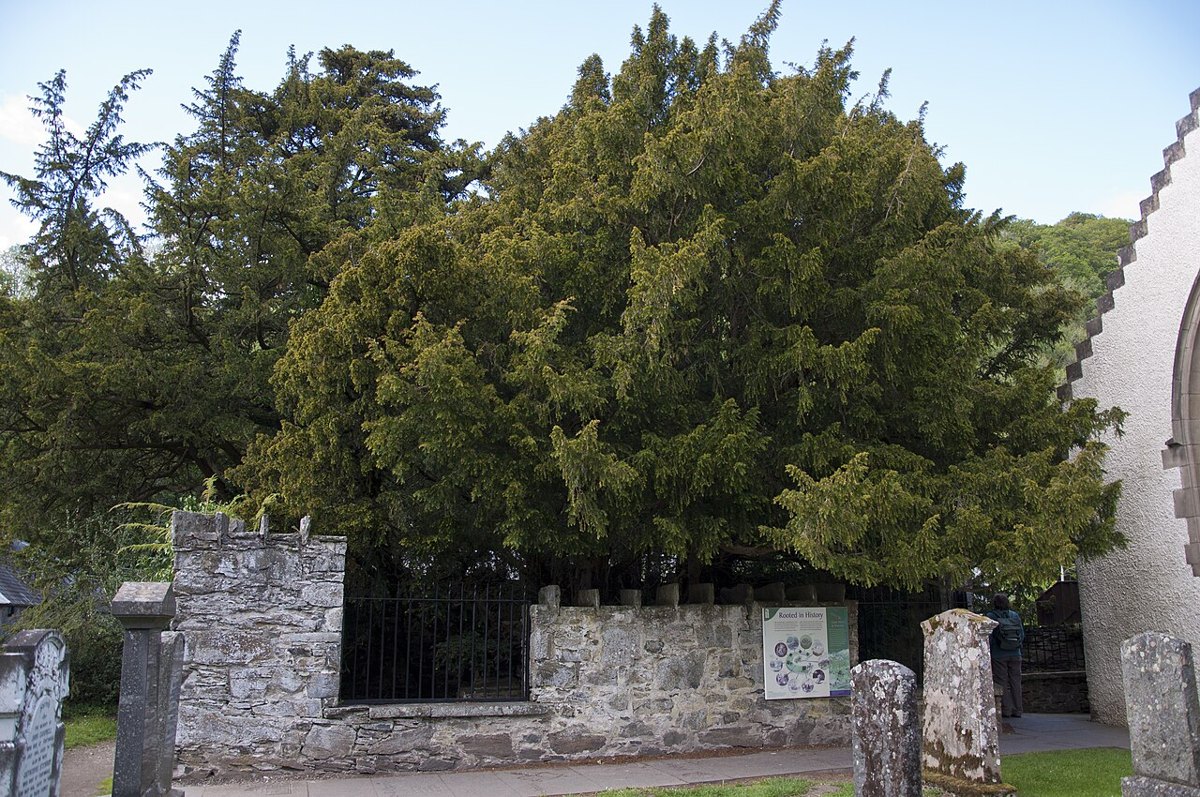
Yews are some of the oldest living things in Europe, although their ages are hard to pin down because old yews go hollow and lose their inner rings.
- The Fortingall Yew in Perthshire, Scotland, grows in a churchyard on a site with Bronze Age and Iron Age remains. Estimates of its age range from about 2,000 years to 5,000, and Forestry and Land Scotland puts it at 5,000 (Wikipedia). A local legend says Pontius Pilate was born in its shade, though historians call that a myth.
- The Llangernyw Yew in Conwy, Wales, is probably over 4,000 years old (Wikipedia).
- The Ankerwycke Yew near Wraysbury, England, stands by the ruins of a 12th-century nunnery and is at least 1,400 years old (Wikipedia).
Greek: Hecate's Tree
In ancient Greece, the yew was sacred to Hecate, goddess of witchcraft, crossroads, and the dead. Yew boughs were burned on funeral pyres (Wikipedia).
Celtic: The Ogham and the Plain of Yews
In the tree tradition of the Irish ogham alphabet, the last of the 20 main letters, idad, is the yew (Wikipedia). One Irish myth, Tochmarc Étaíne, tells of a druid who carved ogham letters on four wands of yew to find a lost queen. The yew also lives on in Irish place names: County Mayo is Maigh Eo, "plain of the yew trees," and Newry comes from a word that may mean "grove of yews."
Scholars still debate whether the old Celtic word eburos, found in the names of tribes like the Eburones and the Roman name for York, meant yew. Julius Caesar wrote that Catuvolcus, a chieftain of the Eburones, took his own life with yew.
Norse and Germanic: Yggdrasil and Eihwaz
Eihwaz, the 13th rune of the Elder Futhark, takes its name from the yew (Wikipedia). The Old English rune poem describes the yew as a tree with rough bark, hard and fast in the earth, "a guardian of flame." Yggdrasil, the world tree of Norse myth, is traditionally an ash, but some scholars believe it was really a yew, and one proposed meaning of its name is "yew pillar" (Wikipedia).
The Yew in Poetry
William Wordsworth wrote about the Borrowdale yews in his 1815 poem "Yew Trees." Sylvia Plath's "The Moon and the Yew Tree," written in 1961 and published in Ariel, sets a yew against the moon over a churchyard (Wikipedia).
Yew Wood Through History
Yew wood is hard and springy, which made it the classic wood for longbows. One of the oldest wooden objects ever found is a yew spear point from Clacton-on-Sea, England, about 400,000 years old. In the Middle Ages, England's demand for yew bowstaves was so great that it nearly wiped out mature yews across much of Europe; by 1472, every ship arriving at an English port had to bring bowstaves with it. Yew was also prized for lutes in 16th-century Venice.
Yew Magical Properties and Correspondences
- Planet: Saturn
- Element: Water
- Sabbat: Samhain
- Rune: Eihwaz
- Ogham: Idad
- Deity: Hecate
- Magical uses: honoring the dead, ancestor work, endurance, protection, transformation, and long life
How to Work With Yew Safely
Yew is poisonous, and its toxins can soak in through the skin, so the safest way to work with yew is through its symbols, not the plant itself. Many practitioners work with yew this way:
- Visit an old yew. Sit near a churchyard yew or one in a park and spend time with it. Look, don't pick.
- Draw or carve Eihwaz. Paint or carve the yew rune on a candle, a stone, or a piece of safe wood for endurance or protection.
- Use yew imagery at Samhain. A photo or drawing of a yew on your ancestor altar honors the tree without bringing the plant inside.
- Write the ogham letter. Draw idad on a card for work around endings and new beginnings.
- Journal with the yew. Ask what in your life needs to end so something new can grow.
- Pair it with safe evergreens. For a physical piece of evergreen, many practitioners use cypress, which is also tied to Hecate and the dead.
Never burn yew, chew it, or bring cuttings into a home with children or pets.
A Simple Yew Endurance Charm
- Draw the Eihwaz rune on a slip of paper or a stone.
- Hold it and think of what you need the strength to get through.
- Say: "Yew of ages, deep and old, root me firm and keep me bold."
- Keep it in your pocket, under your pillow, or on your altar until the hard time passes.
Is a Yew Tree Poisonous?
Yes. Every part of the yew is poisonous except the soft red flesh of the "berry," and the seed inside that red flesh is the most poisonous part (Wikipedia). The toxins, called taxines, affect the heart. Dried yew stays poisonous and can become more toxic as it dries, so fallen needles count too. The toxins can also be absorbed through the skin, which is why gardeners wear gloves when they prune yew, and breathing in yew sawdust has caused poisoning.
If someone eats any part of a yew, call Poison Control at 1-800-222-1222 in the US or get emergency care right away, even if they seem fine.
Yew is also toxic to dogs, cats, and horses, according to the ASPCA. If your pet chews on yew, call your vet or the ASPCA Animal Poison Control Center at (888) 426-4435. Cattle and horses have died after eating yew clippings, so never toss them into a pasture.
Yew Tree FAQ
What does a yew tree symbolize?
The yew symbolizes death and rebirth, eternity, the ancestors, endurance, and protection. It's a poisonous evergreen that grows in churchyards and can live for thousands of years.
Why are yew trees planted in graveyards?
No one knows for certain. Theories include that churches were built on older sacred sites where yews already grew, that the long-lived yew stood for eternity, and that its poison kept grazing animals out of burial grounds.
What is the spiritual meaning of the yew in Celtic tradition?
In the Irish ogham, the yew is idad, the last of the 20 main letters, tied to death and to the soul being reborn in a new form. County Mayo takes its name from the Irish for "plain of the yew trees."
What rune is the yew tree?
The yew is Eihwaz, the 13th rune of the Elder Futhark. It stands for endurance, protection, and the link between life and death.
Is it safe to touch a yew tree?
Brushing past a yew is unlikely to hurt you, but its toxins can be absorbed through the skin, so wear gloves to prune it and wash your hands afterward. Never eat any part of it or burn it.
Are yew berries poisonous?
The red flesh of a yew berry isn't poisonous, but the seed inside it is deadly. Never eat yew berries, and keep children and pets away from them.
How old is the oldest yew tree?
The Fortingall Yew in Scotland is the best-known contender. Estimates range from about 2,000 years to 5,000, and the Llangernyw Yew in Wales is probably over 4,000 years old.
Can I use yew in spells?
Many practitioners work with yew through its symbols rather than the plant: the Eihwaz rune, the ogham letter idad, photos or drawings of yews, or time spent near an old yew. That keeps the meaning without the poison.