Yes, witchcraft is real. It is a practice, not a superpower: people light candles with intention, make charms, brew teas, read cards, keep the moon's calendar, and speak words over jars, and they have done so in every culture on earth for as long as we have records. Witches are real people, more than a million of them in the English-speaking world alone, and the shop that hosts this page sells them their candles. What is not settled is whether a spell changes the world by any means science can measure, and that question has an honest answer too, which is most of what this page is about.
If you searched this because a friend said they were a witch, because you saw a spell on TikTok, or because you are wondering whether to try it yourself, here is the plain version: what witchcraft is, whether witches exist, whether it works, whether it is evil, whether it is a religion, and how to find out for yourself without anyone's permission.
- Is Witchcraft Real?
- Are Witches Real?
- What Witchcraft Actually Is
- What Witches Actually Do
- Does Witchcraft Work?
- Is Witchcraft Evil, Dangerous, or a Sin?
- Is Witchcraft a Religion?
- Is Magic Real?
- Witchcraft Around the World
- How to Find Out for Yourself
- FAQ
Is Witchcraft Real?
Witchcraft is real in the way that cooking, prayer, and gardening are real: it is something people do, with methods, tools, teachers, books, and results they can point to. The word witchcraft has meant different things in different centuries, and most of the confusion in the question comes from mixing them up.
There are three things people mean when they ask:
- Is witchcraft a real practice? Yes, without any argument. Modern witchcraft is a living set of practices, from Wicca, the religion Gerald Gardner built in 1950s England, to eclectic and traditional witchcraft, to the folk-magic traditions that never stopped, like Hoodoo in the American South and brujería across Latin America. Bookstores have shelves of it. Universities have scholars of it.
- Are the effects of witchcraft real? Some are, in ways nobody disputes: a ritual changes how the person doing it thinks, feels, and acts, and that changes outcomes. Whether a spell also acts on the world directly, at a distance, by a force outside of the practitioner, is not proven and not disproven by any experiment, and practitioners themselves disagree about it. The section on whether it works takes that seriously.
- Is the witchcraft of horror films real? No. Nobody is flying, turning people into toads, or cursing a village from a cave. The cackling witch is a character invented by people who were afraid of their neighbors, and the history of that invention is covered below.
So the short answer is: witchcraft is real, witches are real, the practice is real, and the question of "does it work" deserves a longer answer than yes or no.
Are Witches Real?
Witches are real people, and there are a great many of them. The word comes from the Old English wicce and wicca, and for most of history it meant someone the community believed could do magic, for good or ill. Today it mostly means someone who says so themselves.
How many? Counting is hard because no census asks "are you a witch," but the closest surveys give a floor. The 2008 American Religious Identification Survey estimated around 340,000 Wiccans in the United States, and the number of people who identify as Pagan or as practicing witchcraft without the Wiccan label is larger; the 2021 census of England and Wales recorded roughly 74,000 Pagans and 13,000 Wiccans as their religion. The Wicca and modern paganism overviews carry the figures. Add the millions who practice folk magic inside another religion, light a candle for a saint, carry a charm, or read tarot without calling themselves anything, and "witch" turns out to be one of the more common things a person can be.
What a real witch looks like: a nurse who keeps an altar in her bedroom and does a candle spell for a difficult shift. A man who grows herbs, dries them, and makes protection sachets for his front door. A grandmother in New Orleans who has never used the word witch and would be offended by it, and who also knows exactly which oil to dress a candle with. A teenager with a jar of moon water on the windowsill. A coven of nine that meets on the full moon in a suburban living room. Every one of them is real, and none of them looks like the poster.
If you want to meet them, our coven guide covers how to find a safe group, and the difference between witches and Wiccans explains why not every witch is a Wiccan and not every Wiccan calls themselves a witch.
What Witchcraft Actually Is
Witchcraft is the practice of using ritual, intention, and natural materials to influence yourself, your life, and, practitioners hold, the world around you. Our full page on what witchcraft is covers the definition, the word's history, and the types; the short version is that every spell has the same three parts:
- An intention. Something you want: protection for your home, the courage to ask for a raise, the strength to leave, a job, a healed friendship, a quiet mind. Witchcraft is unusually honest about wanting things.
- A ritual. A set of actions done with attention: lighting a candle, writing a petition, tying a knot, brewing a tea, speaking a charm, casting a circle. The ritual is where the intention stops being a thought and becomes a thing you did with your hands.
- Materials with meaning. Candles in colors that stand for things, herbs and stones with long lists of associations, moon phases, days of the week, oils and salts and water. This is sympathetic magic, the oldest idea in the craft: like affects like, and a thing that stands for a thing can act on it.
That is the whole machine. A honey jar spell to sweeten a coworker is a written name, honey, a jar, and a candle burned on top for a few minutes a day. A protection working is black salt across a threshold. Moon water is a jar of water left out overnight with a sentence spoken over it. Nothing in any of that requires a belief you do not already hold; it requires only that you do it on purpose and pay attention.
Witchcraft is not a single religion, a single tradition, or a single set of rules. Wicca is a religion with a witchcraft practice inside it. Hoodoo is a folk-magic tradition inside Black American Christianity. Italian stregheria, Appalachian granny magic, English cunning folk, and a thousand family practices that have no name at all are witchcraft too. The common thread is the method, not the theology.
What Witches Actually Do
Most of what a witch does on an ordinary day would not look like anything to a stranger, because it is small, domestic, and quiet. In rough order of how common each is:
- Keep an altar. A shelf or tabletop with a candle, a few stones, a photo, a plant, a cup of water. Tended daily, or weekly, or when things are hard.
- Work with candles. Choosing a color, carving a word into the wax, dressing it with oil, lighting it with a spoken intention. Our candle color guide is the reference most beginners start with.
- Follow the moon. New moon for beginnings, full moon for charging and release, and a calendar on the wall or the phone.
- Use herbs, oils, and salts. In sachets, baths, floor washes, teas, and jars. This is where witchcraft and folk herbalism overlap so completely that they are the same thing.
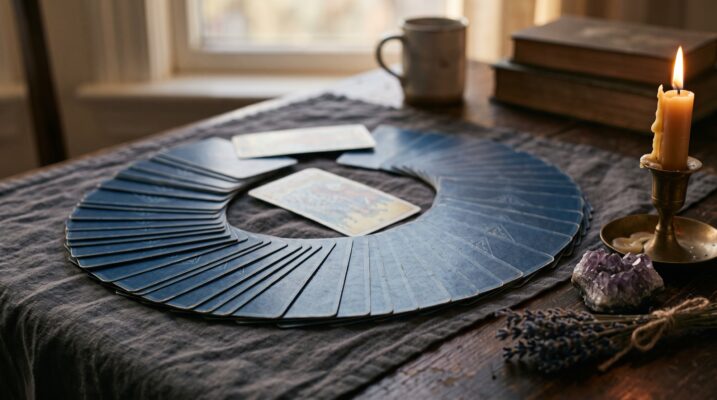
- Divine. Tarot, pendulums, runes, scrying. Asking a question and reading the answer from cards, a swing, a stone, or a bowl of water.
- Cleanse and protect. Smoke, salt, sprays, and words at the doors and windows. The single most common working in every tradition is "keep bad things out of my house."
- Mark the year. The eight sabbats of the Wheel of the Year for Wiccans and many Pagans; saints' days, family days, and the harvest for folk practitioners.
- Study. Books, journals, a Book of Shadows, and a long apprenticeship to their own notes.
What witches do not do, outside of fiction: fly, shape-shift, curse strangers for sport, worship the devil, or sacrifice anything larger than a bay leaf. The Wiccan Rede, "an it harm none, do what ye will," is the ethical rule of the largest modern tradition, and while not every witch follows it, nearly every witch you will meet has some version of it.
Does Witchcraft Work?
Witchcraft reliably works on the person doing it, and whether it also works on the world at a distance is an open question that practitioners answer with their own experience rather than with proof. Both halves of that sentence deserve to be taken seriously, and most pages on this subject only take one.
What witchcraft does that nobody disputes:
- It makes you decide what you want. You cannot do a spell for a vague wish. Writing "a job that pays enough to leave this apartment by spring" on a petition paper is a clarifying act, and clarity changes behavior.
- It changes how you act afterward. A person who has done a courage spell walks into the meeting differently. This is the mechanism behind the self-fulfilling prophecy, and it is not a small thing; it is how most human intentions turn into results.
- It works on the body the way ritual always has. Lighting a candle and breathing over it for ten minutes lowers your heart rate. The placebo effect is real, measurable, and strong, and ritual is one of the best-documented ways to trigger it. A witch who calls this "energy" and a researcher who calls it "expectation" are describing the same event.
- It gives grief, fear, and hope somewhere to go. A protection jar on the windowsill after a break-in does something for the person who made it, whether or not it does anything to burglars.
- It builds attention. Witches notice things: the moon, the season, what is growing, what they feel. Noticing is a skill, and it compounds.
What is not proven:
- Action at a distance. Whether a spell done in one room changes the mind of a person in another, or the outcome of a job interview, or the weather, by any means other than the spellcaster's own subsequent behavior. No controlled study has shown it. That is not the same as a study showing it does not happen, but it is the honest state of the evidence.
What practitioners say: most witches will tell you two things. First, that their spells work far more often than chance, and they keep journals to prove it to themselves. Second, that magic follows the path of least resistance, so a money spell tends to arrive as overtime, a refund, or a side job rather than a bag of cash on the doorstep. A skeptic hears the second point as a way to explain away misses, and the skeptic is not wrong that confirmation bias is real. A witch hears it as an accurate description of how the world responds to intention, and the witch is not wrong that intention plus action produces results.
The most useful answer is the one every serious tradition gives: witchcraft works when you also do the work. A job spell plus fifty applications works. A job spell alone works a good deal less often. Nobody who has practiced for long is confused about this, and any page that tells you a spell replaces effort is selling something.
Is Witchcraft Evil, Dangerous, or a Sin?
Witchcraft is not evil, and the idea that it is comes almost entirely from a specific period of European history in which tens of thousands of people, mostly women, were tortured and executed on the accusation. The witch trials of the early modern period, roughly 1450 to 1750, killed an estimated 40,000 to 60,000 people across Europe and the colonies, including the twenty at Salem. The playbook was the Malleus Maleficarum, a 1486 manual that taught that witches made pacts with the devil, flew to sabbaths, and killed children. None of it was true, and the people who died were healers, midwives, widows with property, the mentally ill, and neighbors someone wanted gone.
The modern witch inherits the word and none of the crimes. Wicca and nearly all modern witchcraft have no devil to worship; Satan is a figure in Christian theology, and most witches do not hold that theology. The ethical center of the largest tradition is "harm none." The most common workings are protection, healing, love, and money. The practice is, for most people, closer to mindfulness with candles than to anything in a horror film.
Is it dangerous? The real risks are ordinary ones. Unattended candles cause fires. Herbs can be toxic, and some cheap crystals are, which is why every recipe on this site names its ingredients and its warnings. Hexing someone you are angry at is a bad idea for the same reason sending the angry email is a bad idea. And the biggest danger in modern witchcraft is fraud: online "spellcasters" who charge hundreds of dollars to remove a curse they diagnosed five minutes earlier are a scam so old that the UK had to pass the Fraudulent Mediums Act against it. No real practitioner tells you that you are cursed and then names a price.
Is it a sin? That depends entirely on whose rules you are asking about, and this page cannot answer it for you. Several Bible passages, Exodus 22:18 and Deuteronomy 18:10 among them, condemn practices translated as "witchcraft" and "sorcery," and Christians who take those passages as binding will say yes. Scholars note that the Hebrew and Greek words behind those translations meant poisoners, necromancers, and diviners-for-hire in their own time, not a woman with a candle and a jar of rosemary. Many practicing witches are also Christians who have made their peace with those passages, and many are not Christians and are not bound by them. If this question matters to you, it is worth reading the passages yourself, in more than one translation, before deciding.
Is Witchcraft a Religion?
Witchcraft is a practice, not a religion, and it lives inside many religions and outside all of them. The distinction matters, because it is the source of most of the confusion about who is a witch.
- Wicca is a religion. It has deities (usually a Goddess and a God), a liturgical calendar (the eight sabbats and the full-moon esbats), an ethic (the Rede), initiations, and clergy. It also has witchcraft as its central practice, which is why "Wiccan" and "witch" get used as synonyms. They are not. Our page on what Wicca is goes deeper.
- Modern paganism is a family of religions, of which Wicca is the largest, and many Pagans practice witchcraft while others do not. A Heathen who honors the Norse gods and a Hellenic polytheist who honors the Greek ones may never cast a spell.
- Folk magic lives inside other religions. Hoodoo practitioners are usually Christian. Italian folk magic sat inside Catholicism for centuries. Curanderismo in Mexico draws on Catholic saints. These traditions are best learned from practitioners within them rather than from a page like this one, and their practitioners often do not use the word witch at all.
- Secular witches exist. A growing number of people practice witchcraft with no deities and no religious belief, treating it as psychology, self-care, and art. They are as real as any other witch.
So: if someone tells you witchcraft is their religion, they usually mean Wicca or another Pagan path. If they tell you it is their practice, they may belong to any religion or none. Both are correct uses of the word.
Is Magic Real?
Magic in the witchcraft sense is real as a practice and unproven as a force, which is the same answer as for witchcraft, and the word itself is the problem. "Magic" means three different things:
- Stage magic is real and is a trick. The magician knows the card was never in the hat. Some witches spell their word magick, with a k, specifically to keep the two apart; the spelling was popularized by Aleister Crowley for that purpose.
- Fantasy magic is fireballs and levitation, and it is not real. Nobody in a coven thinks it is.
- Magic in the witchcraft sense is the practice of influencing events by ritual and will. Whether it influences events by anything other than the practitioner's own changed behavior is the open question from above. What is certain is that people have practiced it in every culture and every century, that it reliably changes the practitioner, and that it has never been made to perform on demand in a laboratory.
If you are asking "is magic real" because you want fantasy magic, the answer is no and the disappointment is understandable. If you are asking because you want to know whether lighting a candle with intention is worth doing, the answer is that it has been worth doing to a very large number of people for a very long time.
Witchcraft Around the World
Witchcraft exists in every culture, and in some places the word still gets people killed, which is worth knowing before you use it lightly. In much of Europe, North America, and Australia, "witch" is a self-description and a bookstore category. In parts of sub-Saharan Africa, Papua New Guinea, and South Asia, "witch" is an accusation, and accusations against children, the elderly, and widows lead to expulsion, violence, and murder every year. Those accusations have nothing to do with the practice on this page; they are the early modern witch hunt still running.
Within living traditions, the picture is rich and specific. Hoodoo is the folk magic of Black Americans, built from West African, Native American, and European practice. Brujería and curanderismo run through Mexico, Central and South America, and the Caribbean. Stregheria is the modern revival of Italian witchcraft. British and Irish cunning folk were the village healers and finders of lost things for centuries. Each has its own rules, its own name for itself, and its own community, and the ones that grew up under oppression are best learned from practitioners within the tradition, not assembled from the internet.
How to Find Out for Yourself
The only way to answer "is witchcraft real" to your own satisfaction is to try it for a month with a journal, because no page, including this one, can hand you the experience. The method is simple and it is the one every teacher gives a new student:
- Pick three small, specific workings. Not "money," but "a check I am owed arrives by the 15th." Not "love," but "a good conversation with my sister this week." Small and specific, so that you can tell whether they happened.
- Do them properly. A candle, a written intention, a few spoken words, ten minutes of attention. Our honey jar spell and candle dressing guide are complete methods with nothing left vague.
- Write down the date, the working, and how you felt. Then leave it alone.
- Do the ordinary work too. Call the sister. Send the invoice reminder. Witchcraft is not a substitute for effort and has never claimed to be.
- Check the journal after thirty days. Look at what happened, what did not, and what changed in you either way. Be as honest about the misses as the hits.
Most people who do this come out one of two ways. Some decide the results were coincidence and the calm was nice, and they stop, having lost nothing but a few candles. Others find that something moved, in the world or in themselves, that they cannot fully account for, and they keep going. Both are reasonable conclusions from the same experiment. If you want a book to walk beside you, Scott Cunningham's Wicca: A Guide for the Solitary Practitioner is the one most working witches started with, and his The Truth About Witchcraft Today was written for exactly the question in this page's title. Our own guide to how to become a witch picks up where this page ends.
FAQ
Is witchcraft real?
Yes. Witchcraft is a real practice followed by a great many people today and throughout history: ritual, intention, and natural materials used to influence oneself and, practitioners hold, the world. What is unproven is whether a spell acts on the world by any means beyond the practitioner's own changed behavior; that question is open, and practitioners answer it from experience.
Are witches real?
Yes. Witches are ordinary people who practice witchcraft, and surveys count hundreds of thousands who identify as Wiccan or Pagan in the United States and the United Kingdom alone, with many more who practice folk magic without using the word. They are nurses, teachers, grandparents, and teenagers, not the figure from folklore.
Does witchcraft work?
Witchcraft reliably changes the person who practices it: it clarifies what you want, changes how you act, and calms the body the way any ritual does, which produces real results. Whether it also acts at a distance, on other people or events, has never been shown in a controlled study and never been ruled out. Every serious tradition says that spells work alongside effort, not instead of it.
Is witchcraft evil?
No. The idea comes from the European witch trials of 1450 to 1750, which executed tens of thousands of innocent people on invented charges of devil worship. Modern witchcraft has no devil in it; its most common workings are protection, healing, love, and prosperity, and the largest tradition's rule is "harm none."
Is witchcraft a sin?
That depends on the religion asking. Several Bible passages condemn practices translated as witchcraft and sorcery, and Christians who read them as binding say yes; scholars note the original words meant poisoners and necromancers rather than modern practitioners. Many witches are Christians who have reconciled the two, and many are not Christian. Read the passages yourself if the question matters to you.
Is witchcraft a religion?
No, witchcraft is a practice. Wicca is a religion that has witchcraft at its center, which is why the words get confused, but witchcraft is also practiced inside Christianity (Hoodoo), Catholicism (curanderismo, Italian folk magic), other Pagan paths, and by secular practitioners with no religion at all.
Is witchcraft dangerous?
The real dangers are practical: unattended candles, toxic herbs and stones, and fraud. Online "spellcasters" who tell you that you are cursed and then charge to remove it are the oldest scam in the field. Working with named, safe ingredients and refusing to pay strangers to lift curses removes nearly all of the risk.
Is magic real?
Magic in the witchcraft sense is a real practice and an unproven force, the same answer as for witchcraft. Stage magic is a trick and fantasy magic is fiction; some witches spell their word "magick" to keep it separate from both.
What is the difference between a witch and a Wiccan?
A Wiccan follows Wicca, a religion founded in the 1950s with a Goddess and God, eight seasonal festivals, and the Rede as its ethic. A witch is anyone who practices witchcraft, inside Wicca or any other religion or none. All Wiccans practice witchcraft; most witches are not Wiccan.
Can anyone become a witch?
Yes. There is no initiation required to practice witchcraft on your own, and most modern witches are self-taught from books and practice. Some traditions and covens do have initiations, and closed folk traditions are best learned from within their communities, but the basic practice of candle, intention, and attention is open to anyone.
How do I know if witchcraft is real for me?
Try it for a month with a journal: three small, specific workings, done properly alongside ordinary effort, with the date and result written down. Judge the journal honestly at the end. That is the test every teacher gives, and it is the only one that answers the question for you rather than for someone else.
If the test leaves you wanting to go further, our guide to the types of witches explains the kinds of practice you can choose from and how to tell which one fits you.