A raven is most often read as a messenger of memory, prophecy, and transformation. It's one of the smartest birds alive, it remembers who treated it fairly, and for thousands of years people have trusted it to carry news between this world and the next. So seeing a raven is read as a sign to pay attention: a message is coming, something hidden is about to surface, or a part of your life is ready to change.
Ravens have a long reputation as birds of ill omen, and it's only half the story. The same bird that sits on a gravestone also perched on Odin's shoulder with news of the whole world, guarded the Tower of London, and helped a young Roman soldier win the duel that gave him his name.
What Does a Raven Symbolize?
A raven symbolizes memory, wisdom, prophecy, transformation, and the link between the living and the dead. Most of those meanings come straight from how the common raven lives.
The main readings practitioners give a raven are:
- Memory. Ravens remember. In a 2011 study, ravens recognized when someone gave them an unfair trade and held onto that memory for a long time, preferring the people who had traded fairly. A raven is read as a keeper of what happened and a reminder that your own history matters.
- Wisdom and insight. The raven's brain is among the largest of any bird's, and ravens solve problems through imitation and insight. A raven is read as a sign to think a situation through before you act.
- Prophecy and messages. From Odin's ravens to the bird at Poe's chamber door, ravens carry news. Many people read a raven as a messenger of things not yet known.
- Death and transformation. Ravens eat carrion, so they have always been seen near the dead. That's where the dark reputation comes from, and also why ravens are read as guides through endings and into whatever comes next.
- Loyalty and partnership. Ravens mate for life, and each pair defends its territory together. When one partner is lost, the survivor has been heard repeating the lost mate's calls. A raven is read as a sign of devoted love and of grief that remembers.
- Play and curiosity. Young ravens slide down snowbanks for fun, play chase with wolves, otters, and dogs, and break off twigs to use as toys. A raven is a reminder that wisdom and play can live in the same bird.
Seeing a Raven: What It Means
Seeing a raven is read as a sign that a message is on its way, or that you're being asked to look closer at something you've been avoiding. Many people read the details of the sighting, too:
- One raven is read as a personal message meant just for you. Notice what you were thinking about when it appeared.
- Two ravens are read as a nod to Huginn and Muninn, Odin's ravens of thought and memory, and a sign to bring your head and your history together on a decision.
- A group of ravens is read as news that's bigger than you, a change coming to your family, your community, or your whole season of life. See the next section for more.
- A raven at your house is read as news coming to your home, or as a guardian watching over it.
- A raven following you is read as a sign that a guide, an ancestor, or your own intuition is trying to get your attention.
- A raven flying overhead is read as a sign to rise above a problem and look at the bigger picture.
- A dead raven is read as the end of a cycle, or a sign to let an old story about yourself go. Don't touch dead birds with bare hands.
A Group of Ravens: What It Means
A group of ravens is called a conspiracy or an unkindness, and seeing one is read as a sign that a message is meant for more people than just you. Many people read a group of ravens as a shift coming to a family or community, a call to gather with your own people, or ancestors drawing close, especially around Samhain.
The real birds explain a lot of that reading. Adult ravens usually live in pairs, so a group is most often young, unmated ravens. They roost together at night and forage alone by day. When one of them finds a large carcass guarded by an adult pair, it flies back to the roost and somehow shares the news, and the next day the whole group arrives together to chase the adults off. Ravens are one of the few animals known to communicate about something that isn't in front of them. So a group of ravens is also read as strength in numbers, and as proof that good news travels.
Raven vs. Crow: How to Tell Them Apart
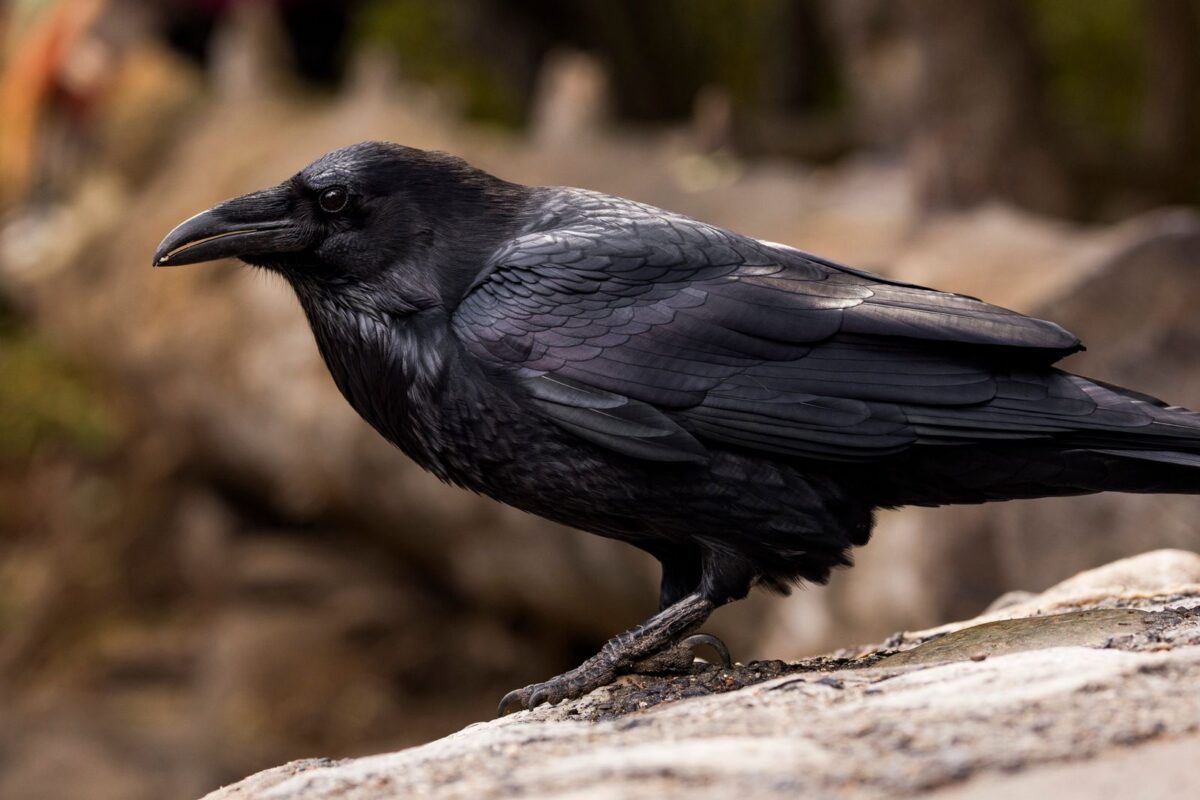
A raven is bigger than a crow, with a heavier, slightly curved bill, shaggy throat feathers, and a wedge-shaped tail. Crows are smaller and sleeker, with a smooth throat and a tail that fans out square at the end. Here's how they compare:
| Common Raven | American Crow | |
|---|---|---|
| Size | 21 to 28 inches long, about the size of a red-tailed hawk | 16 to 21 inches long |
| Wingspan | 46 to 60 inches | 33 to 39 inches |
| Bill | Large, heavy, and slightly curved, with long bristles on top | Smaller and slimmer |
| Throat | Shaggy, pointed feathers that puff out when it calls | Smooth |
| Tail in flight | Long and wedge-shaped, like a diamond | Squared off, like a fan |
| Flight | Soars and glides for long stretches with few wingbeats | Flaps steadily, rarely glides more than a few seconds |
| Voice | A deep, rolling croak | A sharp caw-caw-caw |
For what a crow means spiritually, see our crow spiritual meaning guide.
Raven Sounds: What Does a Raven Sound Like?
A raven most often makes a deep, rolling croak, lower and rougher than a crow's caw. Ornithologists have recorded 15 to 30 different raven calls, including a dry, grating kraa, a high knocking toc-toc-toc, a low rattle, and a few calls that are almost musical. Ravens can also mimic sounds around them, human speech included, and they make sounds without their voices, such as wing whistles and bill snaps.
Many people read the sound, too:
- A raven croaking at you is read as a message you're meant to hear. Notice what was on your mind when it called.
- A knocking or clicking call is read as a sign that something wants to be let in, an idea, a chance, or a spirit.
- A raven that seems to speak is read as a reminder that messages can come in any voice, so listen closely.
Can You Befriend a Raven?
You can earn a raven's trust slowly, but a wild raven should stay wild. Ravens remember the people who treat them well and the people who don't, so being steady and calm around them matters more than anything you offer.
Watch from a respectful distance, keep your trash covered, and don't leave out human food. In the Mojave Desert, landfills and garbage helped the raven population grow about 16-fold over 25 years, and those ravens now prey on young desert tortoises, a threatened species. In the United States, ravens are protected under the Migratory Bird Treaty Act, so keeping one as a pet, or keeping its feathers, is illegal without a permit.
White Raven Meaning
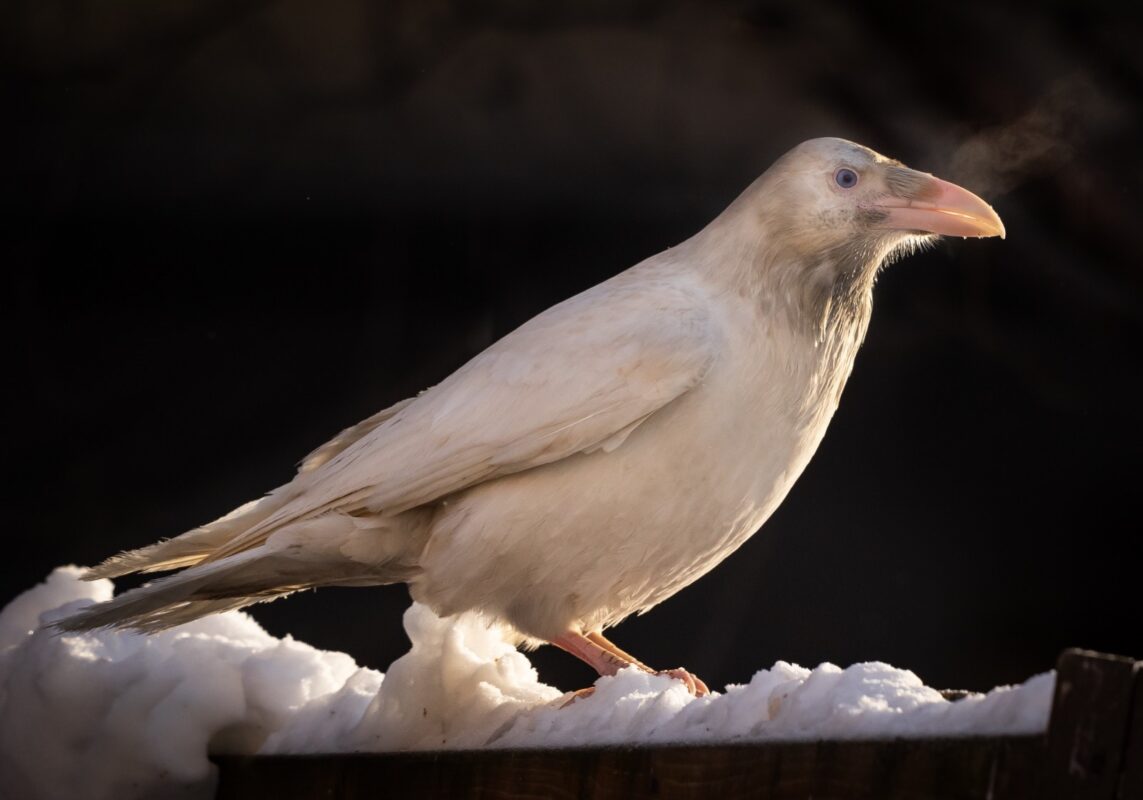
A white raven is read as a rare sign of a miracle, a fresh start, or a message from spirit. White ravens do turn up in the wild. Some seen in British Columbia were leucistic, meaning they lacked several kinds of pigment but kept dark eyes rather than an albino's pink ones.
Ancient Greek and Roman storytellers said all ravens were once white. In Ovid's telling of the myth of Coronis, Apollo left a white raven to guard his pregnant lover. When the raven brought him news that she had been unfaithful, Apollo scorched the bird black in his anger, and that's why ravens are black today. Because of that story, a white raven is also read as truth before it gets twisted, and a black raven as a messenger who carries hard news anyway.
Huginn and Muninn: Odin's Ravens
Huginn and Muninn are the two ravens of the Norse god Odin. Their names come from Old Norse words usually translated as "thought" and "memory" (or "mind"). Every day they fly over Midgard, the world of humans, and come back to tell Odin what they saw.
According to Huginn and Muninn as told in the 13th-century Eddas, the ravens perch on Odin's shoulders, and Odin is called Hrafnaguð, the "raven god." In the Poetic Edda, Odin admits he worries each day that his ravens won't come back, and that he fears for Muninn most. Many readers take that line as a quiet truth about people: losing your memory is a deeper loss than losing a thought.
Norse jarls and kings, including Cnut the Great and Harald Hardrada, carried raven banners into battle. For many people who honor the Norse Deities today, a raven is read as a sign that Odin is near, or as a call toward runes, poetry, and hard-won wisdom. Diana L. Paxson's Odin: Ecstasy, Runes, & Norse Magic is a good place to start if you'd like to know him better.
Raven Meaning in Different Cultures
A raven is read differently from culture to culture, from a creator to a war goddess's messenger to a guardian of a kingdom. Here's where ravens appear around the world:
- Celtic (Irish). The war goddess the Morrígan landed on the hero Cú Chulainn's shoulder in the form of a raven after his death. Many people who work with her today read a raven as her sign. Courtney Weber's The Morrigan: Celtic Goddess of Magick and Might is a warm introduction.
- Welsh. The name of Brân the Blessed translates to "raven" (and "crow"). In the Mabinogion, Brân's head was buried under the White Hill of London, facing France, as a talisman against invasion.
- English. Legend says that if the ravens of the Tower of London ever leave, the Crown will fall and Britain with it. At least six ravens live there, cared for by the Ravenmaster, and some have lived past 40. The Tower's own historian thinks the legend is most likely a Victorian invention, though the Brân story under the same hill is far older.
- Roman. In 349 BC, a young Roman officer named Marcus Valerius accepted a challenge to single combat from a huge Gallic warrior. A raven landed on his helmet and flew at his enemy's face, and Valerius won. Afterward he took the name Corvus, Latin for "raven," and went on to be elected consul six times. In Italy the raven is still il corvo.
- Scandinavian and German folklore. Not every story is kind. In Sweden, ravens were said to be the ghosts of murdered people, and in Germany the souls of the damned.
- Bhutan. The raven is Bhutan's national bird, the kings of Bhutan wear the Raven Crown, and the raven is honored as a form of the protector Mahakala.
- Northwest Coast and Siberia. In Tlingit and Haida tradition, Raven is both a trickster and a creator, and related Raven stories are told among peoples of Siberia and northeast Asia, where the raven Kutkh is said to have made the Kamchatka Peninsula. These are living traditions, and their Raven stories are best learned from practitioners within those nations.
- Jewish and Christian. A raven was the first bird Noah sent out of the ark, before the dove (Genesis 8:7), ravens brought the prophet Elijah bread and meat in the wilderness (1 Kings 17:6), and Jesus told listeners to "consider the ravens," which God feeds though they never sow or reap (Luke 12:24). In these stories a raven is read as a sign of provision.
- Islam. In the Quran, a raven scratching at the ground shows Cain how to bury his brother Abel, and Cain repents.
What Is "The Raven" About? Poe's Raven Meaning
Edgar Allan Poe's "The Raven," first published in January 1845, is about a grieving young man visited at midnight by a raven that can say only one word: "Nevermore." He's mourning his lost love, Lenore. The raven perches on a bust of Pallas Athena above his chamber door, and every question he asks, including whether he'll hold Lenore again in Heaven, gets the same answer.
Poe explained his choice in his 1846 essay "The Philosophy of Composition." He wanted a creature that could speak without reasoning, and he picked a raven over a parrot because it suited the poem's dark tone. He said the raven stands for "Mournful and Never-ending Remembrance."
That's why "quoth the raven, nevermore" still means a loss that can't be undone. It's also why so many people read a raven as a companion in grief, a bird that sits with your sorrow instead of hurrying you past it.
Raven Tattoo Meaning
A raven tattoo usually stands for wisdom, memory, protection, or a connection to someone who has died. The style tells you which meaning the wearer had in mind:
- Norse raven tattoo. Usually Huginn and Muninn, thought and memory, and a sign of devotion to Odin or pride in Norse heritage. Two ravens almost always point to Odin.
- Celtic raven tattoo. Often honors the Morrígan, sovereignty, and fierce protection, sometimes woven with Celtic knotwork.
- Gothic raven tattoo. Most often a nod to Poe, grief, and the beauty in darkness.
- Raven and skull tattoo. Read as a reminder of mortality, and often as a memorial to someone who has died.
- White raven tattoo. Read as rebirth, rarity, or truth.
- Raven with a moon. Read as a bond with magic, intuition, and the night.
Raven Name Meaning
The name Raven comes straight from the English word for the bird. As a name it calls up dark beauty, wisdom, and mystery. It's used for every gender today, and as a masculine name it echoes the Old Norse Hrafn and Old English Hræfn, which were both nicknames and personal names over a thousand years ago.
Raven Dream Meaning
Dreaming of a raven is most often read as a message from your deeper mind, or from an ancestor, about something you already know but haven't faced. Many people read the details:
- A raven speaking to you is read as a message to remember once you wake. Write down what it said.
- A flock of ravens is read as a big change on its way.
- A raven attacking you is read as a hard truth pushing to be heard.
- A white raven is read as a hopeful turn or a fresh start.
The Raven as a Spirit Animal
A raven spirit animal is read as a guide toward memory, magic, and change. Many people prefer the term "animal guide." People who feel close to the raven are often curious, a little mischievous, deeply loyal to the people they love, and comfortable with the parts of life others avoid, like death, grief, and the unknown.
When the raven turns up as your guide, many practitioners read it as a call to:
- Trust your memory and your intuition.
- Look into divination, dreamwork, or ancestor work.
- Welcome a change instead of resisting it.
- Speak a hard truth kindly.
Ravens come up often in October, as people set up ancestor altars for Samhain. A raven statue like this backward-looking raven suits an ancestor altar well, since it looks back toward the people who came before. Some people also wear a small raven amulet as a reminder of the raven's protection and wisdom.
A note on raven feathers: In the United States, the common raven is protected under the Migratory Bird Treaty Act, so keeping raven feathers is illegal without a permit, even ones you find on the ground. If you'd like a feather on your altar, turkey, goose, and guinea hen feathers are legal to own. Our feather meaning guide has more.
Curious which animal guide matches you? Try our free spirit animal quiz. You can also browse every animal on our animal symbolism page. For more birds, see the spiritual meaning of the crow, the owl, the hawk, and the woodpecker.
Raven Meaning FAQ
What does it mean when you see a raven?
Seeing a raven is read as a sign that a message is coming, or that something hidden is about to come to light. Many people also read it as a nudge toward memory, intuition, or a change that's already underway.
What does a raven symbolize?
A raven symbolizes memory, wisdom, prophecy, transformation, loyalty, and the link between the living and the dead.
Is seeing a raven good luck or bad luck?
It depends on who you ask. Some Western folklore treats ravens as omens of death, but in Norse, Celtic, Roman, and many other stories, ravens bring news, food, protection, and victory. Many people today read a raven as a messenger, not a curse.
What does it mean when you see two ravens?
Two ravens are often read as a sign of Huginn and Muninn, Odin's ravens of thought and memory. Ravens also mate for life, so a pair is read as a sign of loyal partnership.
What are Odin's ravens called?
Odin's ravens are Huginn and Muninn, usually translated as "thought" and "memory." They fly over the world each day and come back to tell Odin what they saw.
What does the raven symbolize in Poe's "The Raven"?
Poe said the raven stands for "Mournful and Never-ending Remembrance." Its single word, "Nevermore," tells the grieving narrator that his loss is permanent.
What does a raven tattoo mean?
A raven tattoo usually stands for wisdom, memory, protection, or the memory of someone who has died. Two ravens point to Odin, Celtic designs often honor the Morrígan, and gothic styles nod to Poe.
Can I keep a raven feather I found?
No. In the United States, the common raven is protected under the Migratory Bird Treaty Act, so keeping its feathers is illegal without a permit, even feathers you find on the ground.