Cernunnos is the name scholars give to an antlered god of ancient Gaul, the Celtic lands that are now France and its neighbors. He's shown with a stag's antlers, holding or wearing a torc, often with a ram-horned serpent and seated cross-legged among animals. His name survives on a single carved stone from Roman Paris. Today, many witches and Pagans honor him as the Horned God of the wild and the turning year.
Who Is Cernunnos?
Cernunnos is a Celtic god of animals and the wild. Carvings and metalwork figures from Gaul show an antlered man surrounded by stags, bulls, and other creatures, and the scholar Miranda Green connects him to the old "Lord of the Animals" motif, according to Wikipedia's Cernunnos article.
Some images also give him signs of plenty: a basket of fruit, a cornucopia, or a bag of coins pouring out. So alongside the wild, many people connect him with abundance and the gifts of the land.
Where the Name Comes From: The Pillar of the Boatmen
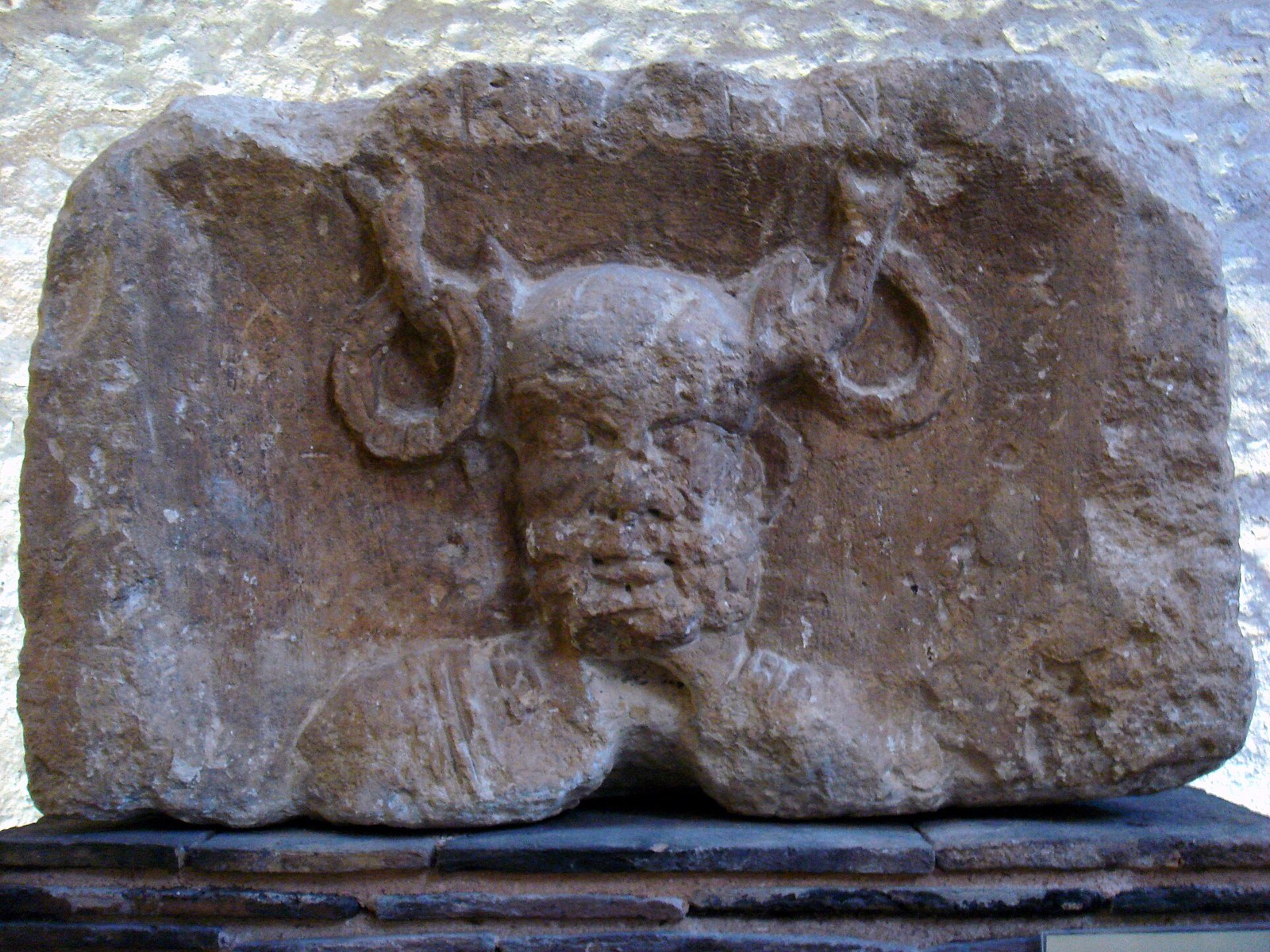
Everything we know about the name Cernunnos comes from one stone. The Pillar of the Boatmen was carved in the reign of the Roman emperor Tiberius (14–37 CE) and dedicated by the boatmen's guild of Roman Paris. Workers found it under Notre-Dame de Paris in the early 1700s, and it's often called the oldest monument in Paris. Today it stands in the Musée de Cluny.
One side shows an antlered figure with torcs hanging from his antlers, and the carving above it was read as "Cernunnos" when the stone was found. The stone is damaged now, and the first letter is gone. The name probably comes from a Celtic word for "horn," but scholars still disagree about its exact meaning, and some question whether the one name belongs to every antlered figure found since.
Cernunnos Symbols
The same handful of symbols appear again and again in his images:
- Antlers. A stag's antlers, the mark of the wild and of the god who rules its animals.
- The torc. A rigid neck ring of twisted metal. Cernunnos wears one, holds one out, or both.
- The ram-horned serpent. A snake with a ram's horns, often held in his hand.
- The stag. He's usually shown with deer and other animals around him.
- The cross-legged pose. He often sits with his legs crossed, a pose seen in other Gaulish carvings too.
- Coins and fruit. A bag of coins, a basket of fruit, or a cornucopia, signs of abundance.
The Gundestrup Cauldron and Other Images
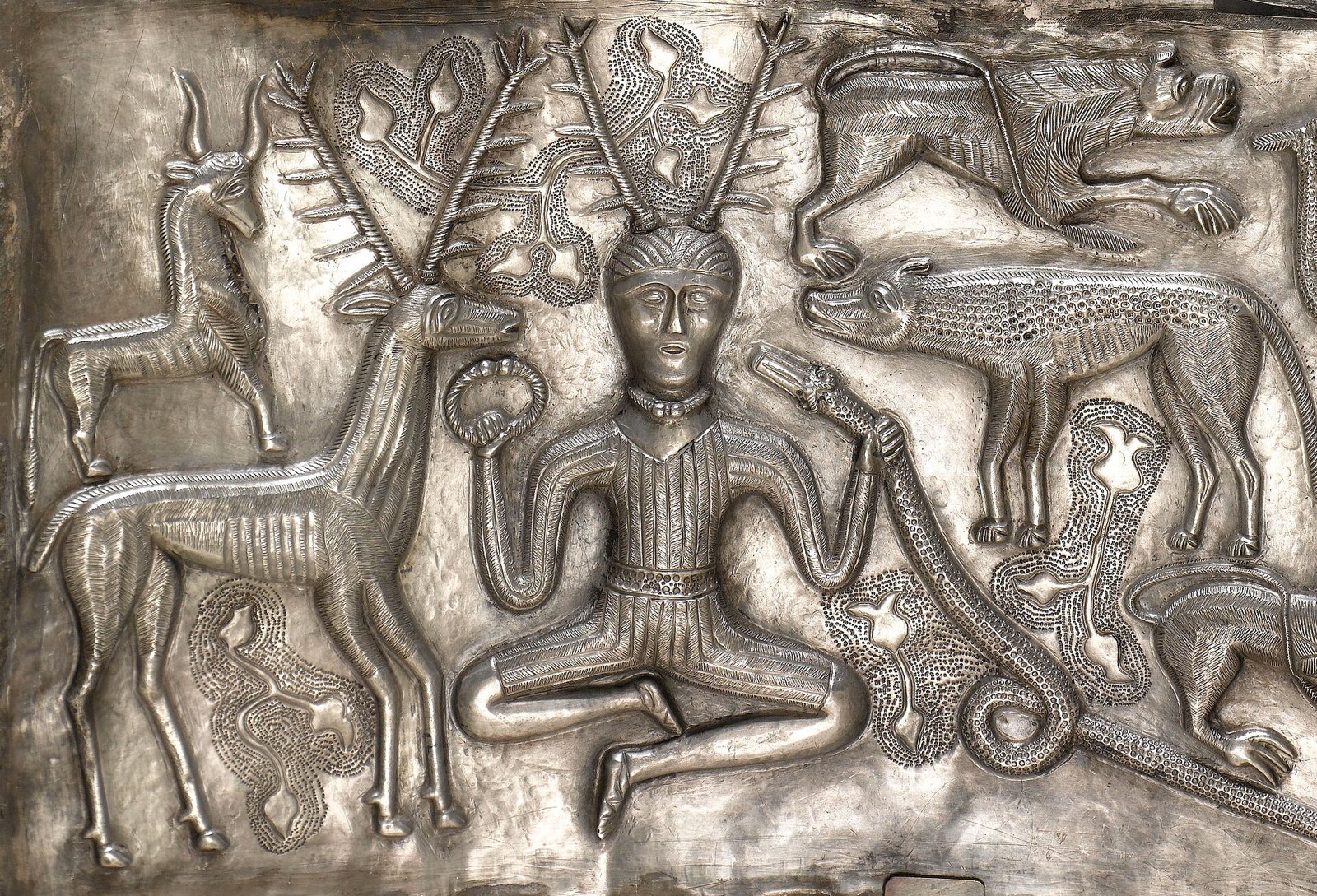
The most famous image of Cernunnos is on the Gundestrup cauldron, a silver vessel peat cutters found in a bog in Denmark in 1891. One of its plates shows an antlered figure seated cross-legged, holding a torc in one hand and a ram-horned serpent in the other, surrounded by animals. Scholars date the cauldron to sometime between 200 BCE and 300 CE, and it's on display at the National Museum of Denmark in Copenhagen.
An even older antlered figure is carved into rock at Val Camonica in northern Italy, from about the 4th century BCE. Another appears on an altar from Reims in France, seated between the Roman Deities Apollo and Mercury. These images look alike, but they span centuries and hundreds of miles, so scholars debate whether they all show the same god or a family of related ones.
Was Cernunnos an Irish God?
No. Cernunnos is known from Gaul and its neighbors, and no Irish or Welsh myth names him. The only Irish link scholars have proposed is a possible connection between his name and Conall Cernach, a hero of the Ulster tales, and that idea rests on a shared word root, not on any story about him. If you've seen Cernunnos described as an Irish god, it's a modern assumption.
The Horned God of Wicca
In Wicca, the Horned God is one of two main Deities, the partner of the Goddess. He stands for the wild, animals, the hunt, and the turning of the year: many traditions say he's born at Yule and dies in the autumn, though groups differ on the exact date, according to Wikipedia's Horned God article.
The idea of a single Horned God comes from the 20th century. The folklorist Margaret Murray argued in The God of the Witches (1931) that a Europe-wide horned god had been worshiped since ancient times, and Gerald Gardner built that idea into Wicca. According to Doreen Valiente, Gardner's own coven called the god Cernunnos. Historians, most notably Ronald Hutton in The Triumph of the Moon, have since shown that Murray's ancient-cult theory doesn't hold up. The Horned God is best understood as a modern figure drawn from older Deities, Cernunnos among them, and many witches honor him with that understanding.
Cernunnos, Pan, Herne, and the Green Man
These four are often blended together, but each has its own history:
- Cernunnos is the antlered god of ancient Gaul, known from carvings and one inscription.
- Pan is the Greek god of the wild and of shepherds, shown with a goat's horns and legs.
- Herne the Hunter is an antlered ghost of English legend said to haunt Windsor Forest. He first appears in writing in Shakespeare's The Merry Wives of Windsor, around 1597.
- The Green Man is a carved face made of leaves, found mostly in medieval English churches, and the name itself was coined in 1939. He isn't Cernunnos, though many modern Pagans treat both as faces of the Horned God.
How to Honor Cernunnos
Here are some of the ways people honor Cernunnos today:
- Build an altar for him. Set out a stag image, a shed antler, or an antlered Horned God statue, a green candle, and fruit or coins, echoing the basket of fruit and bag of coins in his images. Our Horned God Dragonblood Jar Candle burns for about 90 hours.
- Spend time in the woods. He's a god of wild places, so a walk among trees, especially where deer live, is a simple way to feel close to him. Our deer guide covers the stag's own meaning.
- Honor him at Yule. In the Wiccan year, the Horned God is reborn at the winter solstice. Our Cernunnos milk bath is a Yule ritual made for him.
- Leave an offering. Fruit, a coin, or a few words of thanks left outdoors are fitting gifts for a god of plenty and the wild.
- Add the Green Man. If you honor the Horned God as the spirit of growing things, a Green Man Figure Candle brings in that leafy side.
Cernunnos FAQ
Is Cernunnos the same as the Horned God?
Not exactly. Cernunnos is a specific antlered god of ancient Gaul. The Horned God is a modern Wiccan figure who draws on Cernunnos, Pan, and other horned Deities, and many witches use the two names together.
Was Cernunnos an Irish god?
No. He's known from Gaul and nearby regions, and no Irish or Welsh myth names him.
Are Cernunnos and the Green Man the same?
No. The Green Man is a carved face of leaves from medieval churches, and the name dates only to 1939. Some modern Pagans see both as faces of the Horned God.
Did Cernunnos have a wife?
No surviving source names a wife or partner for Cernunnos. In Wicca, the Horned God's partner is the Goddess.
What does Cernunnos symbolize?
He stands for the wild, animals, and abundance. His antlers mark him as lord of the animals, and the coins and fruit in some of his images point to plenty.
How do you pronounce Cernunnos?
Most English speakers say "kur-NOO-nos," with a hard K, the pronunciation Encyclopedia.com gives. The name survives only in writing, so no one knows exactly how the Gauls said it.
Sources
- Cernunnos, Wikipedia
- Pillar of the Boatmen, Wikipedia
- Gundestrup cauldron, Wikipedia
- Horned God, Wikipedia
- Herne the Hunter, Wikipedia
- Green Man, Wikipedia
- Cernunnos, Encyclopedia.com