The Yule goat is a Scandinavian Yule symbol, a goat made of straw and tied with red ribbon, and in Sweden it's called the julbock. Today it's a sweet ornament for trees and windows, but it started out as something much wilder: a costumed goat who barged into farmhouses at Yule, made trouble, and wouldn't leave until he'd been fed. Below you'll find where the Yule goat comes from, how it changed over the centuries, and the story of Sweden's famous Gävle goat.
What Is the Yule Goat?
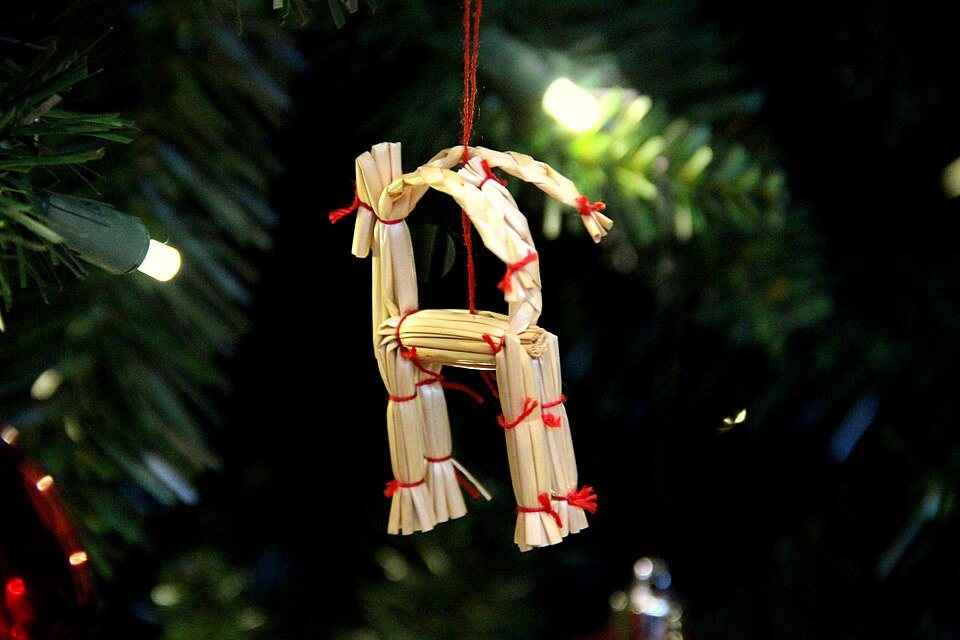
The Yule goat is a Scandinavian and Northern European Yule symbol, and in its modern form it's usually a goat made of straw. It's also called the Christmas goat, and in Swedish it's the julbock, from jul, "Yule," and bock, "billy goat."
You'll find straw Yule goats in every size in Sweden, from little ornaments on the tree to giant goats in town squares.
Where Does the Yule Goat Come From?
Nobody knows exactly where the Yule goat comes from, but there are two popular explanations.
Thor's goats. One popular theory connects the Yule goat to the Norse god Thor, who rode across the sky in a chariot pulled by two goats, Tanngrisnir and Tanngnjóstr.
The last sheaf. The other ties it to the harvest. On old farms, the last sheaf of grain bundled at harvest was thought to hold magical power as the spirit of the harvest. It was saved for Yule and was one of the things called the Yule goat.
The Yule goat is old enough to have gotten into trouble with the authorities. One of the earliest written mentions comes from the theologian Peder Palladius, whose book Visitatsbog was likely written between 1537 and 1560. He noted that the Yule goat had been banned along with other late-night drinking customs.
The Wild Julbock: Sweden's Costumed Goat
Long before the julbock was a straw ornament, it was a person in a goat costume, and he was not polite. Sweden's museum of cultural history, Nordiska museet, describes the julbock as part of the Yule tradition long before the tomte and the Christmas tree arrived.
According to the museum, the julbock came visiting on the day after Christmas: someone dressed as a goat who made mischief, picked fights, "told truths," and butted the farm maids. He only calmed down when he was given food and brännvin, Swedish spirits. Young people went from farm to farm this way, collecting food and drink for a party of their own afterward.
The costumes could be elaborate. The museum's collection includes a goat head of horn and skin on a wooden frame, from Nås in Dalarna in the early 1900s. A string let the wearer clap the goat's lower jaw, which is why it was sometimes called a klapperbock, or "clapping goat." Some goat heads even had a tube running down to a container so that ale or spirits could be poured straight into the goat's mouth.
The Yule goat wasn't always a visitor you could see. In parts of Sweden it was an invisible spirit that turned up before the holiday to make sure the Yule preparations were done right. A straw or rough wooden goat could also be a prank: you'd sneak it into a neighbor's house without being caught, and the family who found it had to pass it on the same way.
Julebukking: Going Door to Door as the Yule Goat
The Yule goat also went door to door. Costumed young men visited houses at Yule or Epiphany, singing, putting on plays, and playing pranks, a custom known from the 1600s that's a little like English wassailing. The group often included the Yule goat, a rowdy and sometimes frightening figure who demanded gifts.
The custom lives on as julebukking, a tradition of Scandinavian origin. Masked and costumed visitors go from house to house between the holiday and New Year's Day, and the hosts try to guess who's under each disguise before offering treats and something to drink.
From Wild Goat to Gift-Bringer
Over time the julbock settled down. Nordiska museet says the custom gradually changed until the julbock became the one who handed out the holiday gifts, a role he kept until the jultomte took over. The museum's verdict: today's straw goats are what's left of a figure that started out wild and unruly.
The goat never fully gave up the job in Finland. There, Father Christmas is still called Joulupukki, which literally means "Yule goat."
The Straw Yule Goat Today
The Yule goat is best known today as a straw ornament tied with red ribbon, placed on or under the tree and in windows all over Scandinavia. Big versions go up in towns and cities every winter, a tradition that started with one very famous goat in Gävle, Sweden.
The Gävle Goat
The Gävle goat (Gävlebocken) is a giant straw Yule goat put up every year in the city of Gävle, Sweden, and it's famous around the world for how often it gets burned down.
According to the City of Gävle, the idea dates to 1966, and on December 1 that year a goat 10 meters (33 feet) high, 7 meters long, and weighing 3 tonnes went up on the city's Castle Square. It has gone up every year since on the first Sunday of Advent, which falls on November 29 in 2026. Tens of thousands of people come to the opening, and fans can watch the goat on a webcam until it's taken down. Building it takes 56 straw mats, about 12,000 knots tied by hand, and some 1,000 hours of work.
Then there's the burning. The very first goat was burned at midnight on New Year's Eve, 1966, and it's been a target ever since. The BBC reports that over the years the goat has survived an attempted kidnapping by helicopter and being rammed by a car, though fire is the usual threat. In 2021 it went up in flames a week before Christmas, after five years in a row of surviving under 24-hour security. By December 2025, 43 of the 60 goats had been destroyed or damaged in some way. Some years the trouble isn't people at all: in 2023 jackdaws pecked at it for the grain left in the straw, and in 2025 a storm blew it over.
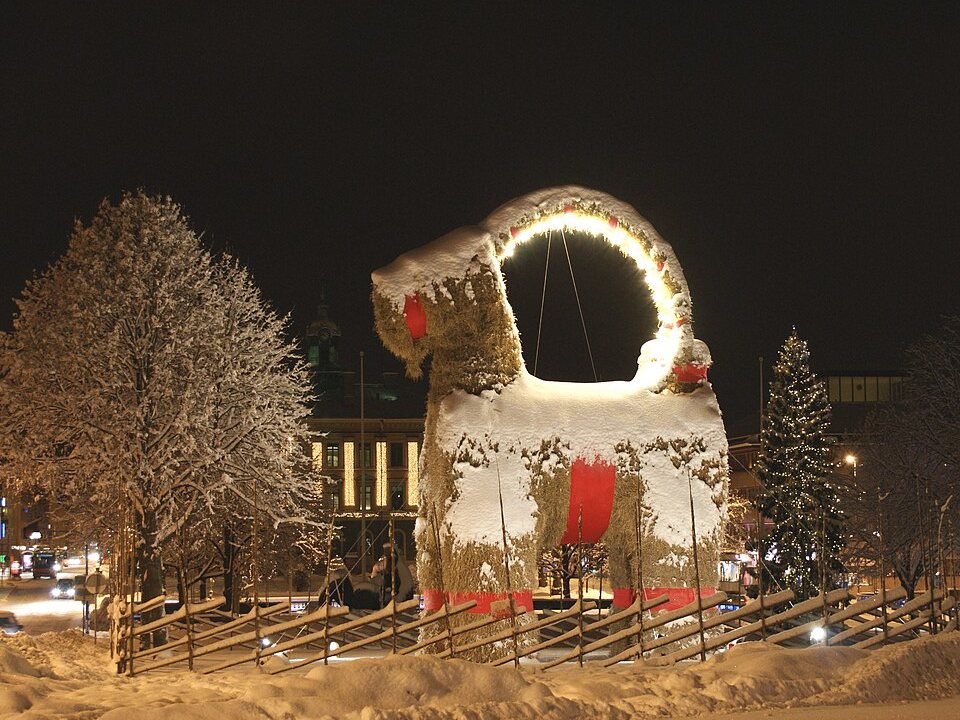
Burning the goat is illegal, but the yearly question of whether it will make it to the new year has turned the Gävle goat into a holiday symbol known around the world.
How to Make a Straw Yule Goat
You can make a small straw Yule goat with a bundle of straw or dried grass, some string, and red ribbon. It takes about an hour and is a lovely way to keep a bit of the harvest through winter, just as the last sheaf was once saved for Yule.
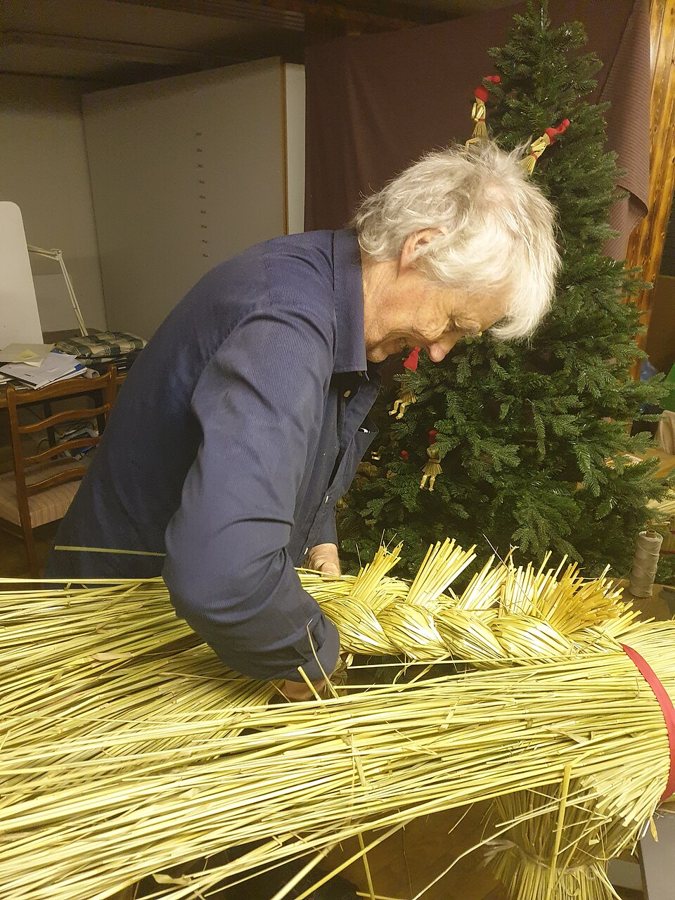
- Gather your straw. Collect a thick bundle of straw, wheat stalks, or long dried grass, about 12 to 18 inches long. Soak it in warm water for 15 minutes so it bends without snapping.
- Make the body. Fold a thick bundle in half and tie it tightly near the fold with string. The folded end is the goat's chest and the loose ends are its tail.
- Make the neck and head. Bend a smaller bundle into a sideways "V" and tie it at the bend to form the head, then tie the lower ends to the front of the body to make the neck.
- Add the horns. Tie two thin twists of straw to the top of the head and curve them back.
- Make the legs. Fold two more bundles into upside-down "U" shapes and push them through the body, one at the front and one at the back, so the goat stands on four legs. Tie them in place.
- Wrap it in red. Cover each string tie with red ribbon or red thread, the classic Yule goat look.
- Let it dry. Set the goat somewhere warm for a day or two to dry and stiffen before you display it.
Bringing the Yule Goat Into Your Own Yule
You can bring the Yule goat into your own celebration in a few simple ways. These are modern ideas inspired by its history:
- Save a sheaf. Keep a small bundle of grain or straw from autumn and make it into a goat at Yule, the way the last sheaf was once saved.
- Put a goat on your altar. A straw goat makes a lovely harvest-to-solstice symbol on a Yule altar, standing for abundance carried through the dark.
- Play the goat prank. Sneak a little straw goat into a friend's home and let them figure out how to pass it on.
- Tell the story by the fire. The rowdy julbock belongs with the other winter visitors of the North, like Iceland's Yule Cat.
For more ways to keep the season, see our guides to what Yule is, winter solstice traditions, and the Yule log.
Frequently Asked Questions About the Yule Goat
What Does the Yule Goat Symbolize?
The Yule goat is often linked to the harvest and to abundance carried through winter, since the last sheaf of the harvest was once saved for Yule and called the Yule goat. A popular theory also connects it to the goats that pulled the Norse god Thor's chariot.
What Is the Yule Goat Called in Swedish?
The Yule goat is called the julbock in Swedish, from jul, "Yule," and bock, "billy goat."
Why Do People Burn the Gävle Goat?
People burn the Gävle goat as an act of vandalism, not a tradition, and doing it is illegal. The giant straw goat has been a target for arsonists since its first year in 1966, and its yearly fate has become a famous Swedish holiday story.
How Many Times Has the Gävle Goat Burned?
As of December 2025, 43 of the 60 Gävle goats had been destroyed or damaged in some way, most often by fire.
When Does the Gävle Goat Go Up?
The Gävle goat goes up on the first Sunday of Advent each year. In 2026, that's Sunday, November 29.
Is the Yule Goat Pagan?
The Yule goat's origins are unclear. Popular theories tie it to the Norse god Thor's goats and to the last sheaf of the harvest. The earliest written mentions date to the 1500s and 1600s.
Featured photo: Gävle goat, 2011 by Tomiwoj, CC BY-SA 3.0, via Wikimedia Commons, cropped.