The Ten of Swords is the tarot card of endings. It shows a figure lying face down under a black sky with ten swords along his back, while the first yellow light of dawn breaks on the horizon, and it's read as the moment something is completely over. Upright, the Ten of Swords is read as an ending, a hard stop, and hitting bottom, with the promise that things can only rise from here. Reversed, it's read as recovering, getting back on your feet, or refusing to accept that something has ended.
The Ten of Swords is the last numbered card in the suit of Swords, the suit of air, the mind, truth, and conflict. Tens are read as the end of a cycle, so this card is read as the final point of a painful stretch, the place where it stops getting worse.
Ten of Swords Keywords
The Ten of Swords' keywords center on endings and new light. Here's how they shift when the card is reversed:
| Upright | Reversed |
|---|---|
| Endings | Getting back up |
| Hitting bottom | Recovery and relief |
| A painful truth out in the open | Learning from what happened |
| The worst is over | Resisting an ending |
| Dawn after a long night | Starting again slowly |
What the Ten of Swords Card Shows
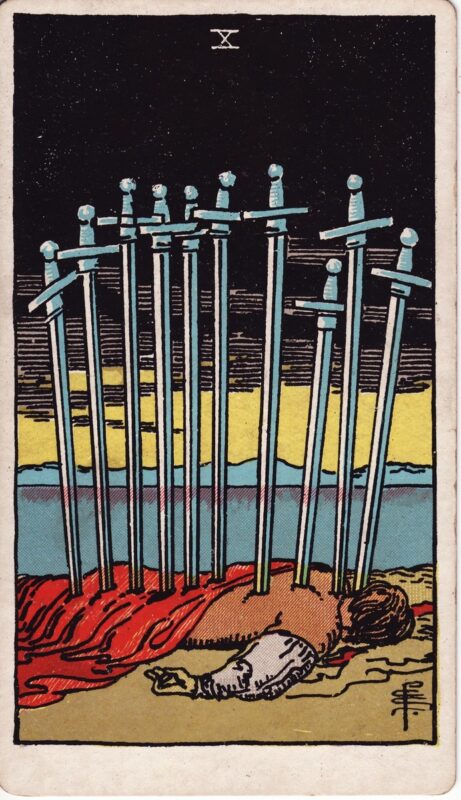
The Ten of Swords card shows a figure lying face down along the edge of still water, with ten swords standing upright along his back and a red cloth draped over him. The sky above is completely black, but along the horizon a wide band of yellow light is breaking over calm blue water and dark hills. The best-known version is the one Pamela Colman Smith painted for the Rider-Waite-Smith tarot, first published in London in December 1909.
Arthur Edward Waite, who designed the deck with her, described the card in his 1910 book, The Pictorial Key to the Tarot, in a single line: "A prostrate figure, pierced by all the swords belonging to the card." Here's what each part of the picture is read as:
- The ten swords are read as every hard thought, word, or blow that led to this point, all at once.
- The figure face down is read as being completely finished with a situation, with nothing left to fight.
- The black sky is read as the darkest part of the night.
- The yellow dawn on the horizon is read as the new day already on its way, the most hopeful detail on the card.
- The calm water is read as stillness after the storm has passed.
Ten of Swords Upright Meaning
The Ten of Swords upright is read as an ending that's final. It often turns up when a relationship, job, plan, or situation has run its full course, or when a hard truth finally comes out. It's read as permission to stop fighting what's already over and let the new day start.
Waite's divinatory meanings included "pain, affliction, tears, sadness, desolation," and he added, "It is not especially a card of violent death." Wikipedia's article on the suit of swords reads it more hopefully, as "a relief from the nightmare of the Nine of Swords," a sign that "the ordeal is over and the truth has been outed." Many readers today read it that way, as the end of the worst of it.
Ten of Swords Upright in Love
In love, the Ten of Swords upright is read as a relationship that has fully ended, or as a painful truth that changes everything. For someone single, it's read as finally closing the door on an old relationship so something new can begin.
Ten of Swords Upright in Work and Money
In work, the Ten of Swords upright is read as a project or job coming to a hard stop, such as a layoff, a closed deal, or a plan that can't go on. With money, it's read as hitting a low point, and as a reason to take stock, ask for help, and rebuild one step at a time.
Ten of Swords Upright in Spirituality
Spiritually, the Ten of Swords upright is read as the end of an old belief or way of practicing that no longer holds up, and as the clearing that makes room for something truer.
Ten of Swords Reversed Meaning
The Ten of Swords reversed is read in two ways. Most often, it's read as getting back up after a hard ending, slowly recovering your footing, and seeing the lesson in what happened. It can also be read as refusing to let an ending happen, dragging out something that's already over, or bracing for a blow that has already landed.
Waite's reversed meanings were "advantage, profit, success, favour, but none of these are permanent; also power and authority," so the reversed card has long been tied to things turning around, with a reminder not to count on any one moment lasting forever.
Ten of Swords Reversed in Love
In love, the Ten of Swords reversed is read as moving on after a breakup, or as starting to trust again. It can also be read as holding on to a relationship that has already ended.
Ten of Swords Reversed in Work and Money
In work, the Ten of Swords reversed is read as bouncing back after a setback, such as finding a new role or rebuilding a project. With money, it's read as a slow, steady recovery.
Ten of Swords Reversed in Spirituality
Spiritually, the Ten of Swords reversed is read as finding your way back to your practice after a hard season, and as a reminder that endings and beginnings come in cycles.
Ten of Swords as Feelings
As feelings, the Ten of Swords upright is read as someone who feels finished, worn down, or done with a situation, sometimes with the relationship itself. Reversed, it's read as someone who is starting to feel lighter and more hopeful after a hard stretch.
Is the Ten of Swords a Yes or No Card?
The Ten of Swords upright is usually read as a no, especially for questions about getting back together or saving something. Reversed, it's usually read as "not yet, but things are turning," a sign that the worst is behind you.
Ten of Swords Correspondences
The Ten of Swords takes its correspondences from its suit and its number:
| Ten of Swords | |
|---|---|
| Suit | Swords (also called Blades) |
| Element | Air |
| Number | Ten |
| Golden Dawn number link | Tens are linked with Earth |
| Arcana | Minor Arcana |
| Zodiac signs | None of its own; Swords are linked with the air signs Gemini, Libra, and Aquarius |
In tarot reading, the suit of swords is associated with intellect, and also with sorrow and misfortune, and the element of air has been associated with the suit. In the Hermetic Order of the Golden Dawn, the number cards of the Minor Arcana are each linked to a planet or body, and the tens are linked with Earth, which fits a card about solid, final endings.
How to Work With the Ten of Swords
The Ten of Swords is a good card to work with when something has ended and you're ready to stop replaying it. Many practitioners use it at sunrise, since the card itself shows the dawn arriving. Here's a simple practice for closing a chapter.
You'll need:
- The Ten of Swords card from your deck, such as the Gold Rider-Waite tarot deck
- A citrine, such as a citrine tumbled stone, which many practitioners keep for sunny, hopeful energy
- A sheet of paper and a pen
- A window that faces the morning light, if you have one
- Wake a little before sunrise and set the Ten of Swords card by the window, with the citrine beside it.
- On the paper, write what has ended, in plain words, and one thing you learned from it.
- Fold the paper in half and place it under the card.
- As the light comes up, hold the citrine and recite:
Night is long but dawn is near,
What has ended frees me here. - Tear the folded paper into small pieces and recycle them, or bury them in the soil.
- Carry the citrine with you for the rest of the day as a reminder that a new day has started.
If you keep a tarot journal, the Ten of Swords is a good card to write about when you pull it. A few prompts to try:
- What am I still fighting that's already over?
- What did this ending teach me?
- What would I like the next chapter to look like?
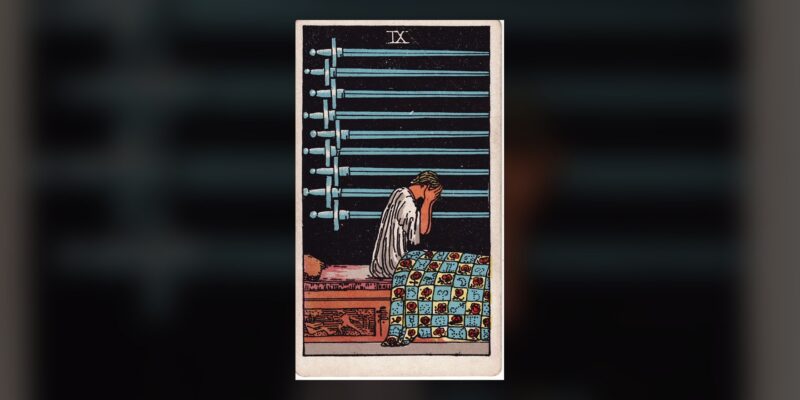
Our guide to keeping a tarot journal has a free printable page for it. For the meanings of all 78 cards in one place, see our guide to tarot card meanings. You can also read about the Nine of Swords, the long night that comes just before this card, and the Queen of Swords, who is often read as someone who has come through hard endings wiser for them.
Ten of Swords FAQ
What does the Ten of Swords mean?
The Ten of Swords is the tarot card of endings. Upright, it's read as a final ending, hitting bottom, and the worst being over. Reversed, it's read as recovering and getting back up, or as resisting an ending.
What does the Ten of Swords reversed mean?
The Ten of Swords reversed is most often read as recovering after a hard ending and slowly getting back on your feet. It can also be read as dragging out something that's already over.
Is the Ten of Swords a yes or no card?
The Ten of Swords upright is usually read as a no, especially for questions about saving something. Reversed, it's usually read as "not yet, but things are turning."
What does the Ten of Swords mean in love?
In love, the Ten of Swords upright is read as a relationship that has fully ended, or a painful truth coming out. Reversed, it's read as moving on and starting to trust again.
Does the Ten of Swords mean death?
No. Waite himself wrote that "it is not especially a card of violent death." The Ten of Swords is read as the end of a situation or chapter, with the dawn on the card read as a new beginning.
Why is there a sunrise on the Ten of Swords?
The yellow light on the horizon is read as the new day arriving. It's the reason the Ten of Swords is often read as the worst being over, since the night on the card is already ending.
What zodiac sign is the Ten of Swords?
The Ten of Swords has no zodiac sign of its own. Swords cards are linked with the air signs Gemini, Libra, and Aquarius.
Is the Ten of Swords a bad card?
It's a hard card, but not a hopeless one. The Ten of Swords is read as the low point of a cycle, the place where things stop getting worse and the dawn starts to show.