The Five of Wands is the tarot card of conflict and competition. It shows five young men raising and crossing their staves at once, with no one clearly winning, and it's read as the clash of ideas, egos, and energy that happens when everyone wants to be heard. Upright, the Five of Wands is read as competition, disagreement, and friction. Reversed, it's read as finding common ground, avoiding a fight, or tension that's being kept under the surface.
The Five of Wands belongs to the suit of Wands, the suit of fire, energy, ambition, and creative drive. Fives are read as a point of challenge in each suit, so this card is read as the moment all that fire runs into someone else's.
Five of Wands Keywords
The Five of Wands' keywords center on conflict and competition. Here's how they shift when the card is reversed:
| Upright | Reversed |
|---|---|
| Competition | Finding common ground |
| Conflict | Avoiding conflict |
| Disagreement | Tension kept hidden |
| Clashing egos | Agreeing to disagree |
| Friendly rivalry | Calm after the scuffle |
What the Five of Wands Card Shows
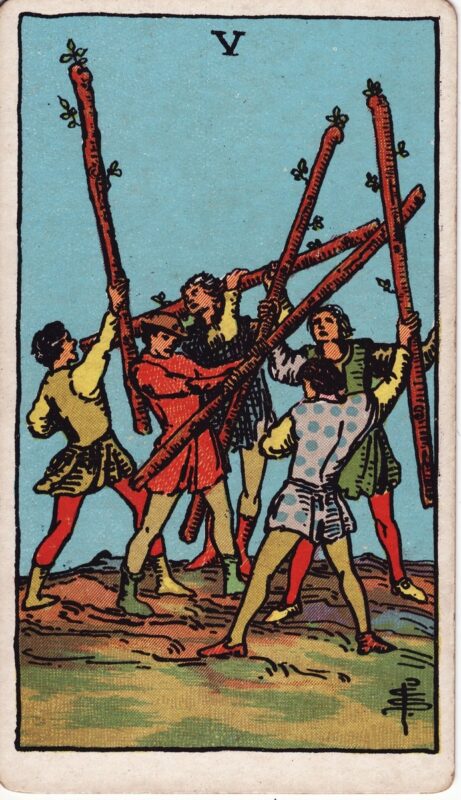
The Five of Wands card shows five young men, each in a differently colored tunic, raising long wooden staves and crossing them overhead on a patch of rough ground. No one is hurt and no one seems to be winning, and the sky behind them is a clear pale blue. The best-known version is the one Pamela Colman Smith painted for the Rider-Waite-Smith tarot, first published in London in December 1909.
Arthur Edward Waite, who designed the deck with her, described the card in his 1910 book, The Pictorial Key to the Tarot, as "a posse of youths, who are brandishing staves, as if in sport or strife. It is mimic warfare." Here's what each part of the picture is read as:
- The five staves are read as five different ideas, goals, or voices all pushing at once.
- The crossed staves are read as friction, where each person's effort gets in another's way.
- The different tunics are read as different backgrounds and points of view.
- The fact that no one is hurt is read as a sign that the conflict is more noise than danger, closer to a scrimmage than a battle.
- The rough ground is read as a situation that hasn't settled yet.
Five of Wands Upright Meaning
The Five of Wands upright is read as competition or friction. It often turns up when you're in a busy group project, a crowded market, a family debate, or any situation where too many people are pushing in different directions. It's read as a sign that the conflict is manageable, and that some friction can sharpen your ideas if everyone stays respectful.
Waite's divinatory meanings were "imitation, as, for example, sham fight, but also the strenuous competition and struggle of the search after riches and fortune." He added, "In this sense it connects with the battle of life." That's why the card is still read as the everyday competition of work, ambition, and getting ahead.
Five of Wands Upright in Love
In love, the Five of Wands upright is read as arguments, bickering, or mismatched goals in a relationship. For someone single, it's read as competing for someone's attention, or as playful back-and-forth with a new interest.
Five of Wands Upright in Work and Money
In work, the Five of Wands upright is read as competition for a role, clashing opinions on a team, or a crowded field. With money, it's read as needing to work a little harder to stand out, and as a reason to keep your plans clear and simple.
Five of Wands Upright in Spirituality
Spiritually, the Five of Wands upright is read as feeling pulled between different teachings or opinions, and as a nudge to find what feels true for you.
Five of Wands Reversed Meaning
The Five of Wands reversed is read as conflict winding down or going underground. It often points to finding common ground, agreeing to disagree, or deciding a fight isn't worth having. It can also be read as avoiding a needed conversation, so the tension stays under the surface.
Waite's reversed meanings were "litigation, disputes, trickery, contradiction," so the reversed card has long been tied to disagreements that grow more formal or more tangled. Many readers today read it more gently, as the moment the scuffle settles.
Five of Wands Reversed in Love
In love, the Five of Wands reversed is read as making peace after an argument, or as finally talking through a recurring disagreement. It can also be read as avoiding conflict so long that resentment builds.
Five of Wands Reversed in Work and Money
In work, the Five of Wands reversed is read as a team coming together, a rivalry cooling off, or a compromise. With money, it's read as settling a disagreement over shared costs or plans.
Five of Wands Reversed in Spirituality
Spiritually, the Five of Wands reversed is read as quieting the inner debate and settling into a practice that feels right.
Five of Wands as Feelings
As feelings, the Five of Wands upright is read as someone who feels frustrated, competitive, or caught in a back-and-forth with you. Reversed, it's read as someone who wants to make peace, or who is tired of arguing.
Is the Five of Wands a Yes or No Card?
The Five of Wands upright is usually read as "maybe, with effort," since you'll have to work through some competition or disagreement to get there. Reversed, it's usually read as a cautious yes once the conflict settles.
Five of Wands Correspondences
The Five of Wands takes its correspondences from its suit and its number:
| Five of Wands | |
|---|---|
| Suit | Wands (also called Rods, Staves, or Batons) |
| Element | Fire |
| Number | Five |
| Golden Dawn number link | Fives are linked with Mars |
| Arcana | Minor Arcana |
| Zodiac signs | None of its own; Wands are linked with the fire signs Aries, Leo, and Sagittarius |
In tarot reading, the suit of wands is tied to fire, and Wikipedia notes that "Wands cards often represent the astrological signs of Fire: Leo, Sagittarius and Aries." In the Hermetic Order of the Golden Dawn, the number cards of the Minor Arcana are each linked to a planet, and the fives are linked with Mars, which fits a card about conflict and competition.
How to Work With the Five of Wands
The Five of Wands is a good card to work with when a group, a household, or your own mind feels full of competing voices. Many practitioners use it before a team meeting or family conversation. Here's a simple practice for finding common ground.
You'll need:
- The Five of Wands card from your deck, such as the Gold Rider-Waite tarot deck
- A blue tiger's eye, such as a blue tiger's eye tumbled stone, which many practitioners keep for calm, clear communication
- Five small slips of paper and a pen
- A larger sheet of paper
- Set the Five of Wands card in the center of the larger sheet of paper, with the blue tiger's eye beside it.
- On each small slip, write one voice or point of view in the situation, including your own.
- Place the five slips in a circle around the card, like the five figures on it.
- Hold the stone over the card and recite:
Sparks may fly but fires unite,
Turn the clash to common light. - Look at the slips and write, in the center of the larger sheet just above the card, one goal or value that all five voices share.
- Bring that shared goal into your next conversation about the situation, and keep the blue tiger's eye with you as a reminder to listen first.
If you keep a tarot journal, the Five of Wands is a good card to write about when you pull it. A few prompts to try:
- Where am I competing when I could be collaborating?
- Which disagreement in my life is actually helping me grow?
- What do the people I'm clashing with and I both want?
Our guide to keeping a tarot journal has a free printable page for it. For the meanings of all 78 cards in one place, see our guide to tarot card meanings. You can also read about the Seven of Wands, who holds the high ground against six challengers, and the Three of Wands, where plans start to reach out into the wider world.
Five of Wands FAQ
What does the Five of Wands mean?
The Five of Wands is the tarot card of conflict and competition. Upright, it's read as disagreement, friction, and rivalry. Reversed, it's read as finding common ground, avoiding conflict, or tension kept under the surface.
What does the Five of Wands reversed mean?
The Five of Wands reversed is read as conflict winding down, such as agreeing to disagree or reaching a compromise. It can also be read as avoiding a needed conversation.
Is the Five of Wands a yes or no card?
The Five of Wands upright is usually read as "maybe, with effort." Reversed, it's usually read as a cautious yes once the conflict settles.
What does the Five of Wands mean in love?
In love, the Five of Wands upright is read as arguments or mismatched goals. Reversed, it's read as making peace or talking through a recurring disagreement.
What does the Five of Wands mean as feelings?
As feelings, the Five of Wands upright is read as someone who feels frustrated or caught in a back-and-forth with you. Reversed, it's read as someone who wants to make peace.
Is the Five of Wands a real fight?
Usually not. Waite called it "mimic warfare," and on the 1909 card no one is hurt. It's read as friction and competition rather than serious danger.
What zodiac sign is the Five of Wands?
The Five of Wands has no zodiac sign of its own. Wands cards are linked with the fire signs Aries, Leo, and Sagittarius.
Is the Five of Wands a bad card?
Not really. The Five of Wands is read as a busy, noisy card, but the conflict is manageable, and friction can sharpen ideas when everyone stays respectful.