The Devil is the tarot card of attachment and temptation. It shows two people chained to a dark pedestal beneath a horned figure, with chains so loose they could lift them off, and it's read as the habits, desires, and ties that hold you more than you'd like. Upright, the Devil is read as feeling stuck, temptation, and giving your power away. Reversed, it's read as breaking free, seeing a pattern clearly, or loosening a grip that's held you too long.
The Devil is card number XV in the Major Arcana, the 22 named cards of the tarot deck. Despite its name, it isn't read as evil or as a sign of anything sinister in your life. Waite himself described its meaning as "that which is predestined but is not for this reason evil."
The Devil Keywords
The Devil's keywords center on attachment and the choice to break free. Here's how they shift when the card is reversed:
| Upright | Reversed |
|---|---|
| Attachment | Breaking free |
| Temptation | Seeing a pattern clearly |
| Feeling stuck | Taking your power back |
| Materialism | Letting go of what holds you |
| Giving your power away | A fresh sense of freedom |
What the Devil Card Shows
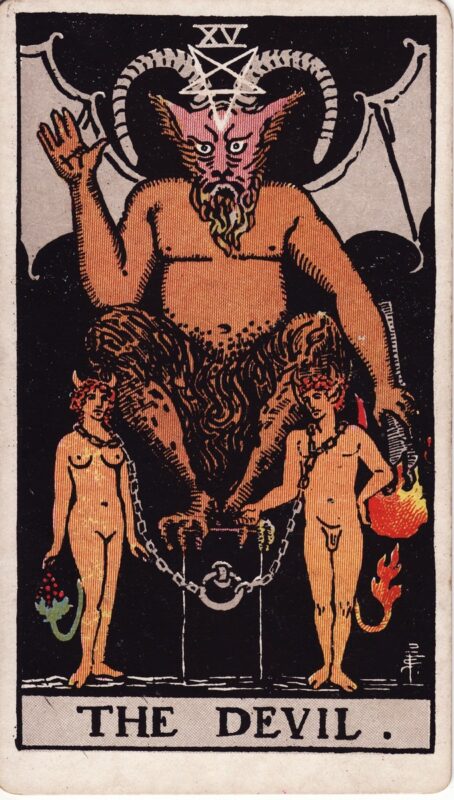
The Devil card shows a horned figure with bat wings squatting on a black pedestal, with a man and a woman standing below him, each with a loose chain around the neck. The best-known version is the one Pamela Colman Smith painted for the Rider-Waite-Smith tarot, first published in London in December 1909.
Arthur Edward Waite, who designed the deck with her, described the card in his 1910 book, The Pictorial Key to the Tarot. He wrote that "the Horned Goat of Mendes, with wings like those of a bat, is standing on an altar," that "a reversed pentagram is on the forehead," and that the two figures below are tied to the altar by chains. Here's what each part of the picture is read as:
- The loose chains are read as the most important detail on the card. They hang loosely enough to lift over the figures' heads, so the card is read as a hold you could step out of once you see it.
- The two figures are read as people caught in a habit or attachment. Waite compared them to "Adam and Eve after the Fall," and their small horns and tails are read as how a pattern can start to change you.
- The inverted pentagram above the horned figure's brow is read as spirit placed beneath material desire, the reverse of the upright pentagram.
- The lowered torch in his left hand is read as energy turned toward the material world.
- The raised right hand is read as the opposite of a blessing. Waite wrote that it's "the reverse of that benediction which is given by the Hierophant."
- The black background is read as not being able to see a situation clearly from inside it.
Waite also wrote that the horned figure "is not to be their master for ever," which is why the card is read as temporary rather than permanent.
The Devil Upright Meaning
The Devil upright is read as being held by something you've given more power than it deserves. It often turns up around a habit you keep returning to, a relationship that feels hard to leave, a job you stay in only for the money, or a pattern of thinking that keeps you stuck. It's read as an invitation to look honestly at what holds you, and to notice that the chains are looser than they seem.
Waite's divinatory meanings were "ravage, violence, vehemence, extraordinary efforts, force, fatality; that which is predestined but is not for this reason evil." Today the card is read less as a warning of harm and more as the pull of strong desires and the ties that come with them.
The Devil Upright in Love
In love, the Devil upright is read as an intense, magnetic attraction, or as a relationship built more on habit, jealousy, or control than on freedom. For someone single, it's read as returning to an old pattern or an ex who isn't good for you.
The Devil Upright in Work and Money
In work, the Devil upright is read as feeling trapped in a job, staying for the paycheck, or being caught up in office politics. With money, it's read as spending to fill a gap, or as debt that feels like a chain, and as a reason to look at your choices with clear eyes.
The Devil Upright in Spirituality
Spiritually, the Devil upright is read as a time to look at your shadow, the parts of yourself you'd rather not see. Many practitioners read it as a call to honest self-reflection rather than fear.
The Devil Reversed Meaning
The Devil reversed is read as breaking free. It often points to seeing a pattern clearly for the first time, setting a boundary, ending a habit, or walking away from something that held you. It can also be read as a pattern getting stronger because you're not yet ready to look at it.
Waite's list for the reversed card was "evil fatality, weakness, pettiness, blindness," so the reversed Devil has long been tied to not seeing what's in front of you. Many readers today read it the opposite way, as the moment the blindfold comes off.
The Devil Reversed in Love
In love, the Devil reversed is read as leaving a pattern that wasn't good for you behind, setting boundaries, or finally walking away from a relationship that felt like a trap. It can also be read as rediscovering freedom within a relationship.
The Devil Reversed in Work and Money
In work, the Devil reversed is read as leaving a job that felt like a cage, or as standing up to a difficult situation. With money, it's read as getting spending or debt back under control.
The Devil Reversed in Spirituality
Spiritually, the Devil reversed is read as shadow work paying off, and as a lighter, freer sense of yourself.
The Devil as Feelings
As feelings, the Devil upright is read as someone who feels a strong, almost irresistible pull toward you, sometimes mixed with possessiveness or jealousy. Reversed, it's read as someone who wants more freedom, or who is trying to let go of an attachment.
Is the Devil a Yes or No Card?
The Devil upright is usually read as a no, or as a warning to look closely at your reasons for wanting something. Reversed, it's usually read as a yes when the question is about breaking free or leaving something behind.
Where the Devil Comes From
The Devil has been part of tarot decks since the earliest trump sequences, but its look has changed a great deal. According to Wikipedia's article on the Devil:
- In the Tarot of Marseilles and other decks before the 1800s, the Devil has bat-like wings, antlers, a face on its belly, eyes on its knees, and lion feet, with two horned and tailed creatures bound to a round pedestal.
- In the Rider-Waite-Smith deck, the Devil is based partly on Éliphas Lévi's famous 1855 drawing of Baphomet, a winged, horned figure with a raised right hand and a lowered left hand.
- In the Fool's journey, the story many readers tell through the Major Arcana, the Devil comes right after Temperance and stands for getting caught up in material things and complacency.
The Devil Correspondences
The Devil's correspondences come from the Golden Dawn and astrology:
| The Devil | |
|---|---|
| Number | XV (15) |
| Arcana | Major Arcana |
| Planet | Saturn |
| Zodiac sign | Capricorn |
| Element | Earth (through Capricorn) |
Wikipedia's article on the Devil links the card with the planet Saturn and the earth sign Capricorn. That fits a card about structure, limits, and the pull of the material world. Many practitioners work with the Devil around times of self-reflection, such as a waning moon, when letting go comes more naturally.
How to Work With the Devil
The Devil is a good card to work with when you want to loosen the hold of a habit, pattern, or attachment. Many practitioners use it during a waning moon. Here's a simple practice built on the card's loose chains.
You'll need:
- The Devil card from your deck, such as the Gold Rider-Waite tarot deck
- A piece of black obsidian, such as a black obsidian free shape, which many practitioners keep for honest self-reflection
- A length of string or cord, about 12 inches
- A pair of scissors
- Set the Devil card upright in front of you and hold the obsidian for a few slow breaths.
- Name, out loud or silently, one habit, pattern, or tie you'd like to loosen.
- Tie the string in a loose loop around your wrist, loose enough to slip off, like the chains on the card.
- Hold the obsidian over the card and recite:
Loosened chain and lifted weight,
I walk free through my own gate. - Slip the loop off your wrist without untying it, then cut it once with the scissors.
- Throw the string away outside your home, and keep the obsidian beside the card for a week as a reminder of the choice you made.
If you keep a tarot journal, the Devil is a good card to write about when you pull it. A few prompts to try:
- What do I keep going back to, even when I know it doesn't serve me?
- Where have I given my power away?
- What would I do if I trusted that the chain was loose?
Our guide to keeping a tarot journal has a free printable page for it. For the meanings of all 78 cards in one place, see our guide to tarot card meanings. You can also read about the Fool, whose journey passes through the Devil, and the King of Pentacles, who shows the material world held in a balanced way.
The Devil Tarot Card FAQ
What does the Devil tarot card mean?
The Devil is the tarot card of attachment and temptation. Upright, it's read as feeling stuck, strong desires, and giving your power away. Reversed, it's read as breaking free and seeing a pattern clearly.
What does the Devil reversed mean?
The Devil reversed is most often read as breaking free, setting a boundary, or ending a habit that held you. It can also be read as a pattern getting stronger because you aren't ready to look at it yet.
Is the Devil a yes or no card?
The Devil upright is usually read as a no, or as a warning to check your reasons. Reversed, it's usually read as a yes for questions about leaving something behind.
What does the Devil mean in love?
In love, the Devil upright is read as an intense attraction, or a relationship built on habit, jealousy, or control. Reversed, it's read as setting boundaries or walking away from a pattern that felt like a trap.
Is the Devil card evil?
No. The Devil isn't read as evil or as a sign of anything sinister. Waite described its meaning as "that which is predestined but is not for this reason evil," and today it's read as the pull of habits and attachments.
Why are the chains loose on the Devil card?
The chains around the two figures' necks hang loosely enough to lift off. That's why the Devil is read as a hold you can step out of once you see it clearly.
What zodiac sign is the Devil tarot card?
The Devil is linked with Capricorn, an earth sign, and with the planet Saturn.
Is the Devil a good card to get?
It's a challenging card, but a useful one. The Devil is read as a chance to notice what's holding you back, and the loose chains are read as a sign that you can choose to step free.