Sadness is water. It moves the way water moves: rising in the body, pooling in the chest, asking to be acknowledged before it can recede. When you feel sad, something inside you is reporting accurately. A loss has happened, or a love has reached the edge of what was, or a season is ending. The tears are not a malfunction; they are the body doing what it was built to do.
A spell for sadness does not turn the water off. It traces the feeling to its root, names what is true beneath it, and gives the sadness somewhere to go.
The Ritual
You will plant something living in the imagination, name it after the goal it will grow into, and let your tears water it. Grief becomes nourishment. The sadness does not leave you, exactly. It changes shape. It takes root. Ensure you become the master of that root before it becomes the master of you.
This is meditative work. The plant lives in the inner garden, not on the windowsill, which means the spell cannot be undone by a forgotten watering or a too-cold winter. The garden grows wherever you are.
When to Cast
Cast on a Monday (the Moon's day, sacred to Water) or under a waning moon, when the work is to release without erasing. Evenings are kind to this spell; the day is winding down, the body is tired enough to let the feeling come. If you need this spell now, cast it now. Timing strengthens, but readiness is what makes the spell.
Materials
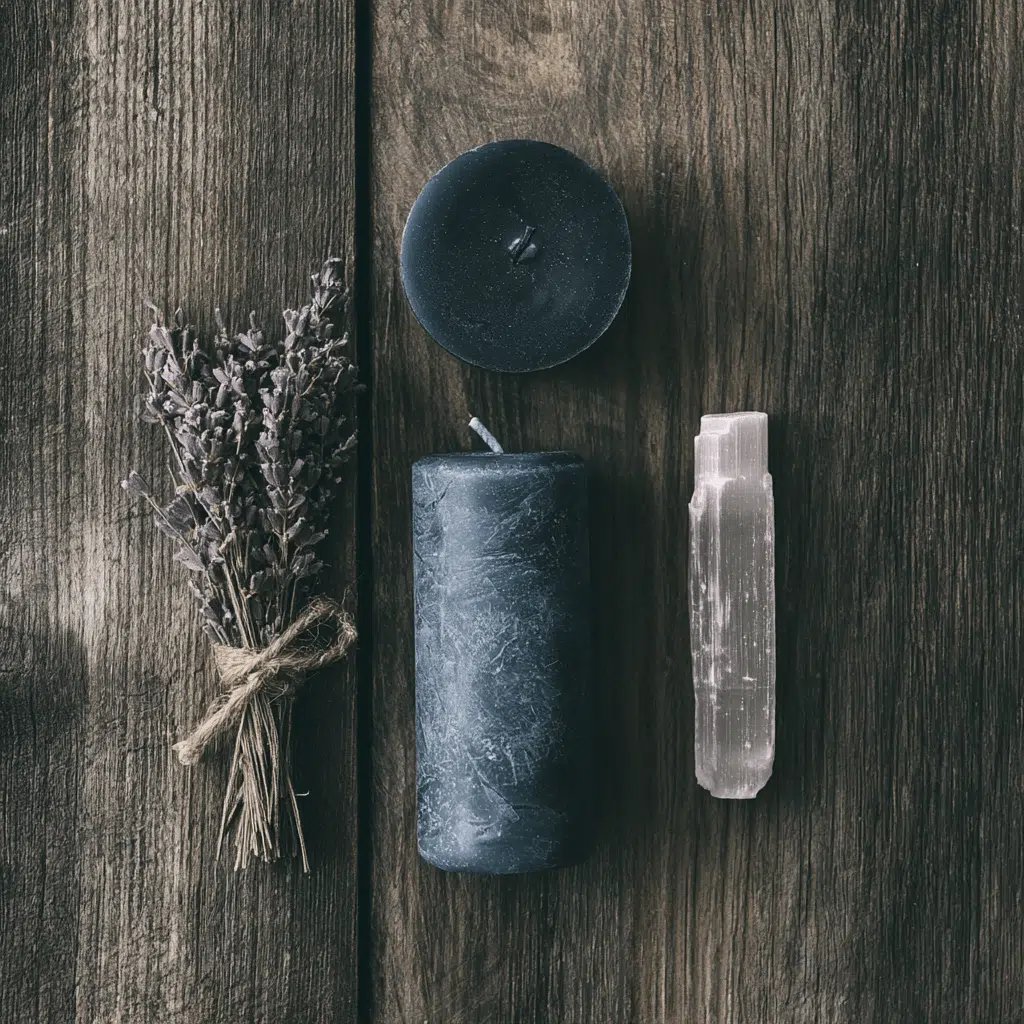
- Blue Pillar Candle, used as the altar flame; the Water-coded blue holds the vibration of the working.
- Selenite Sticks, used to harmonize and balance the energies that go out of order as you process the sadness; selenite is the steady hand on the altar while you transform what is heavy into something beautiful and beneficial.
- Whole Lavender Flowers, kept close throughout the working; lavender is the herb you ask, again and again, to soften the rough edges when the feeling becomes too large to bear.
Why These Materials
Water is the element of emotion and connection and life; sadness is one shape it takes inside the body. The materials honor that wider lineage while keeping the working grounded enough to hold real feeling. The blue pillar candle holds the Water vibration and gives the meditation a focal flame. Selenite is named for Selene, the Moon, and it does not simply clear; it harmonizes, restoring order to whatever has been knocked sideways by grief. Lavender is the herb of softening, the one that lets the body unclench just enough to let the feeling rise without panic. The plant itself lives in your imagination, where it cannot wither and where you are the only weather. The grief gets a job. The job is to feed something inside you that wants to grow.
The Ritual
- Choose the plant and name it. Before you begin, picture a plant whose energy matches the goal you want to grow. Name the plant after the goal it will grow into: love returning, the book finished, the version of me who lives in the new house. The plant is the goal. See its leaves clearly. See the soil it grows from. From this point on, the plant carries the name, and you will be able to find it in your inner garden whenever you visit.
- Cleanse and set the altar. Pass a selenite stick slowly through the air around your altar space, asking it not just to clear but to harmonize, to bring the energies of the room and the energies inside you back into balance. Light the blue pillar candle. Place the selenite where you can see it; it will keep watch through the working. Take three slow breaths and let the feeling rise; do not push it down.
- Engage the lavender and speak the charge. Take a small pinch of lavender between your fingers and lift it to your nose. Breathe in slowly. Ask lavender, plainly, to soften the rough edges of what is coming. Set the lavender within easy reach; you will reach for it again. Read the charge aloud, naming the plant where the brackets are.
- Call in a meditative state, and ask for help. Use whatever method you trust to settle into meditation: counted breath, a guided recording, a body scan, a few minutes of silence with your eyes closed. When you are settled, call in your favorite deities, ancestors, guides, or whatever divine company you keep. Ask them, in your own words, to keep you safe and comforted as you process this sadness. You do not have to grieve alone, and you do not have to do this work without protection. Wait until you feel them with you before you go further.
- Sit with what comes, and trace it to its root. Let the sadness rise. Then ask, plainly: what am I actually grieving? Whose face is in my mind. What thing did not happen. What season is ending. What part of myself am I missing. Name the answer, silently or aloud. This is the work the feeling came to do. Once you have the answer, hold it next to the name of the plant. The sadness is the energy, and you are choosing how to transform it. Energy cannot die; it can only change its form. That is the law your spell is leaning on.
- Water the plant with what your sadness summoned. Notice the water in your body. Tears welling, the heaviness in the chest, the wet ache behind the face. Sadness has called water to the surface; that is what sadness does. Now picture your inner garden. See the plant you named. When the water in you feels too full, pour it out: see it leaving your eyes as tears falling onto the soil, or moving down through your chest and out through your hands into the soil at the plant's roots, or rising from the ache itself and arcing toward the plant in a slow stream. Water is water, no matter how it was summoned or where it flows next. It is mutable. The grief does not become less grief because you direct it; it becomes useful. Pour as long as feels right.
- When the feeling crests, breathe the lavender. If the sadness becomes too large to bear, do not push it down and do not run from it; reach for the lavender. Lift it to your nose and breathe in deeply, then breathe out longer than you breathed in. Remind yourself: like a flash flood, this will pass. Stay with the feeling, but let the scent take the sharpest edge from it. Come back to the visualization when you are steady enough. Repeat as many times as you need to. The lavender is a tool you can use again and again throughout the working.
- Close the working and commit. When you are ready, see the plant settled into the soil, watered, alive. Thank the deities, ancestors, or guides you called in, and release them with gratitude. Open your eyes. Snuff the candle (do not blow). Tell the plant, silently, how you will tend it: a daily visit, a weekly check-in, a quiet hello whenever you walk past your altar. The spell is the relationship, not this single working. Ground yourself afterward by drinking a glass of water, eating something simple, or stepping outside into air.
The Charge
Sadness, I see you. I am not afraid of you.
You are water in me, and water can always transform and flow.
I am planting [name of plant] in my inner garden.
I am pouring my sadness into its soil.
Energy cannot die. It can only change.
Tonight, I am the one who chooses what it becomes.
My plant [name of plant] can only grow.
After the Spell

Let the candle burn for a while if you can; if you must leave, snuff it and relight on your next visit until it has burned down completely. Visit the plant in your imagination as often as you like, not because the sadness demands it, but because the plant is yours and growing things deserve company. Some witches keep a small notebook beside the altar and write a single line on each visit: what they're grieving today, what they're tending toward, what the plant looks like now. Over time the notebook becomes a kind of grief-and-growth journal, witness to both the feeling and the changing. The plant in the inner garden grows in proportion to the visiting.
If the feeling returns next week, next month, next year, the spell did not fail. Sadness comes in waves. The plant is your shore. Tend the root, but do not move into the root; the witch lives in the house, not in the soil. You are the master of what grows here.
Frequently Asked Questions
Why a visualized plant instead of a real one?
Because the spell should never depend on green-thumb talent. A real plant introduces a second working, keeping it alive, that has nothing to do with grief and can quietly poison the spell when the plant struggles. The inner garden cannot wilt. It can be visited from a hospital bed, a hotel room, a long flight, anywhere you can close your eyes.
What if I don't have all the materials?
Any blue or white candle will serve in place of the blue pillar; tealights work in a pinch. Lavender can be substituted with chamomile or any other herb that calms you. The visualization is the only irreplaceable element. Everything else can flex.
What if I can't picture the plant clearly?
You don't need cinematic detail. A felt sense of the plant is enough: knowing it is there, knowing where it grows, knowing its name. Some witches see vivid leaves; others sense only the shape of presence. Both are working magic.
If visualization is difficult for you, anchor the plant in something physical. Print a photo of the plant you've chosen and place it on your altar, or sketch it on a card, or write its name on a slip of paper folded into the shape of a leaf. Speak to the photo or the card the same way you would speak to the plant in your inner garden. Aphantasia and low-visualization minds work magic every day; the trick is to give the plant a place to live that your mind can return to, whatever that place looks like for you.
What if I don't have a meditation practice or a relationship with deities?
Start where you are. The meditative state can be as simple as sitting still with closed eyes and counting ten breaths. The protective company can be ancestors you have known, a beloved who has passed, the part of yourself that has always taken care of you, or simply the room you are in. The spell does not require advanced practice. It requires honest reaching.
How will I know it worked?
Look for small somatic shifts: a softer breath, less weight in the chest, sleep that feels different. Look at the plant in your inner garden the next time you visit. The spell works in seasons, not seconds; some witches notice the change most after weeks, when the plant has visibly grown alongside their slow return to themselves.
What if the feeling comes back?
It will. Sadness is wave-shaped; that is its nature, not a sign the spell failed. Visit the plant. Each visit is the spell continuing. Over time the relationship to the feeling changes, and that change is the working, not a single release.
If the sadness is too heavy to hold alone, please reach out, to a trusted person, a therapist, or a crisis line. Magic is real, and so is the value of human support. The candle and the helpline can sit on the same altar.